
Painted Majus Dowry Chest From Saurashtra - 19th Century
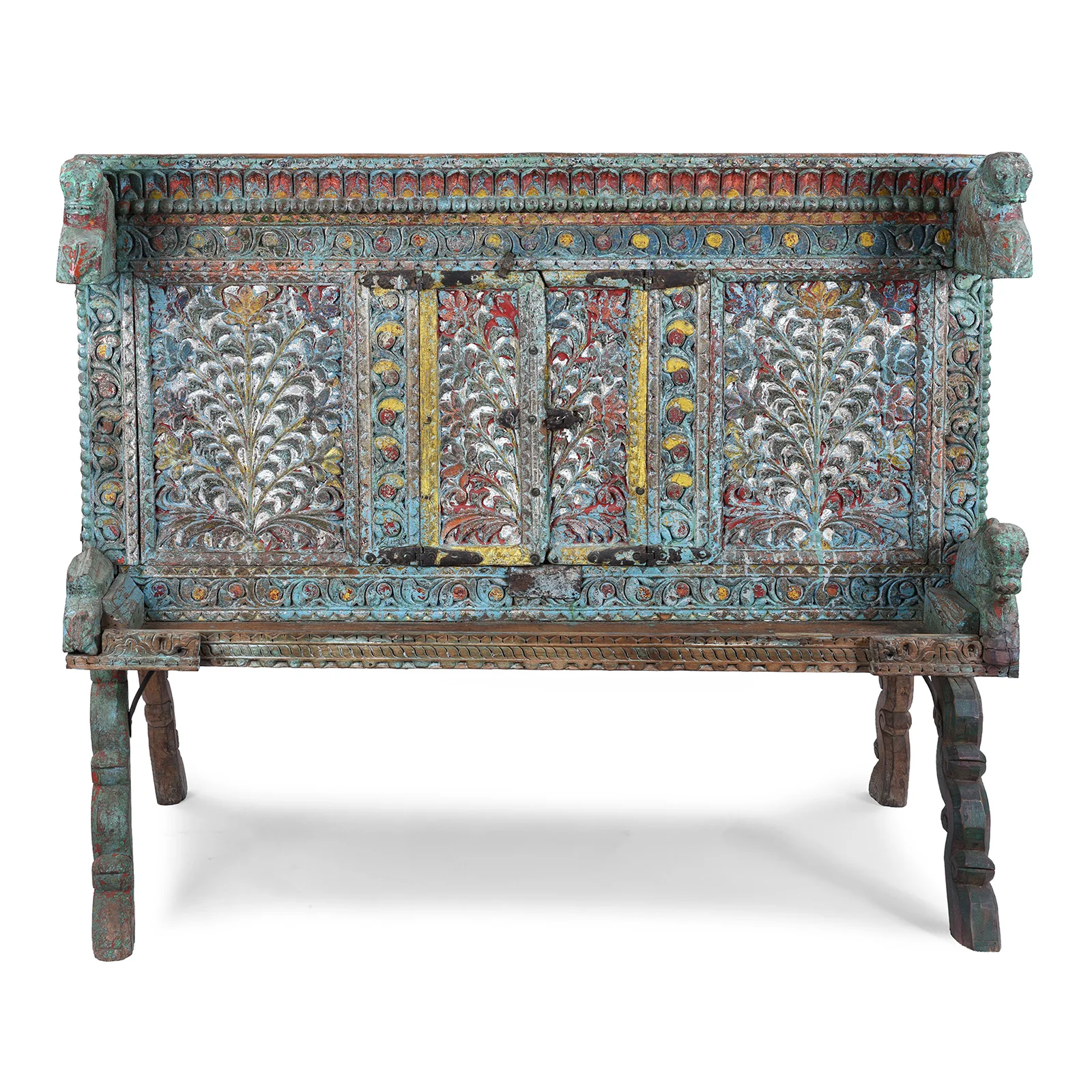
This beautifully carved and richly patinated antique Indian dowry chest is a fine example of a Majus (Majju / Manjush) dowry chest made by the Kathi community of Saurashtra, Gujarat, dating to the 19th century. These chests traditionally transported a bride’s possessions, including jewellery, silk saris, and occasionally brass cooking vessels, to her new household. They were also used within the home to store leftover food for future meals.
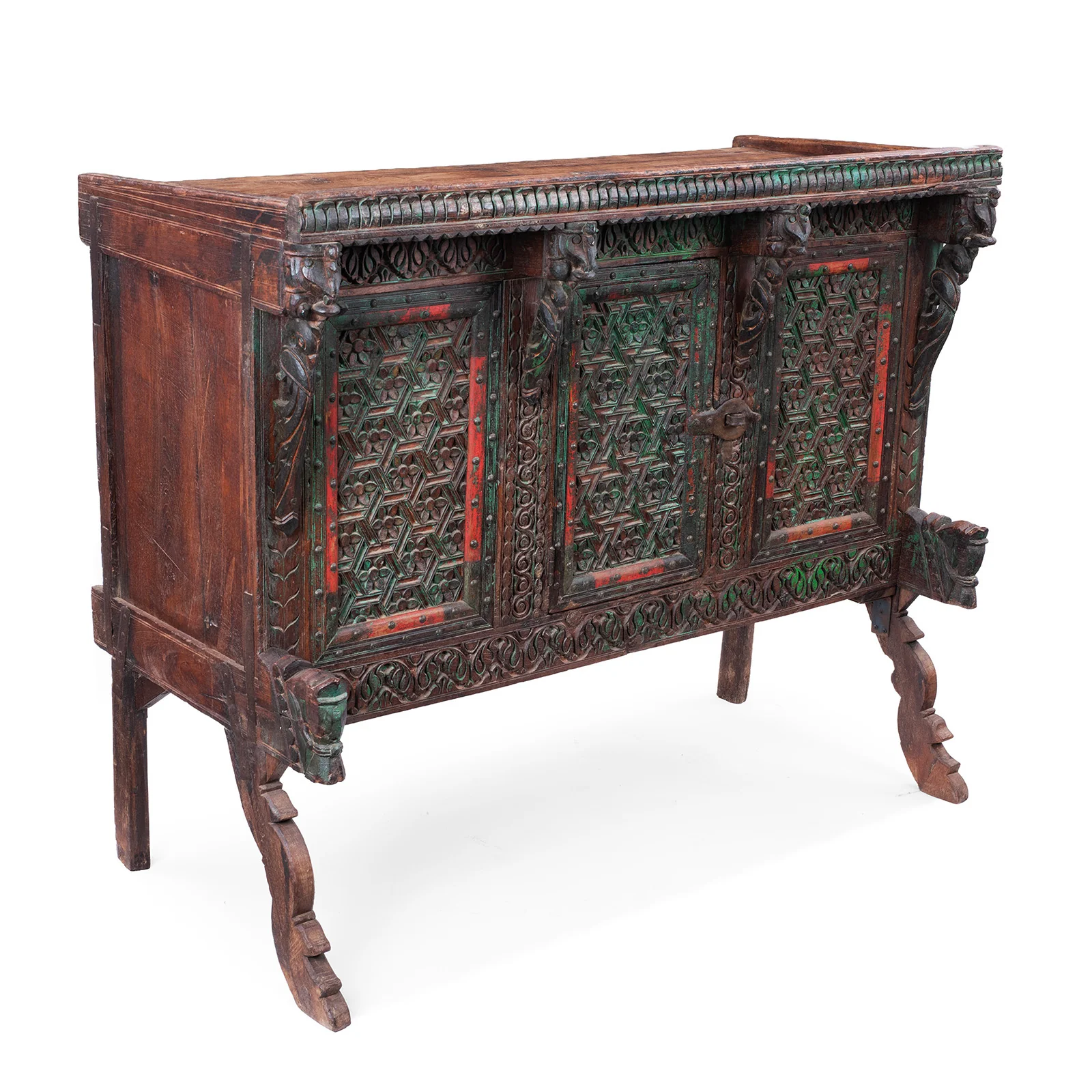
The chest is adorned with finely carved geometric panels enriched with remnants of old red and green pigments and framed with red lacquer beading. The façade combines Mughal-influenced floral and geometric carving, while the distinctive horse-head legs and upper row of carved parrots are hallmark features of Kathi Majus chests. Crafted from solid teak, it stands on sculptural legs and retains a wonderfully timeworn surface.
Reference: See a near identical example in “Folk Art & Culture of Gujarat: A Guide to the Collection of the Shreyas Folk Museum of Gujarat” by Jyotindra Jain, Kathi section, fig. 59.
- Origin: Saurashtra, Gujarat, India
- Date: 19th Century
- Materials: Solid teak with traces of original pigment
- Features: Finely carved geometric panels; Mughal-style motifs; horse-head carvings; carved parrot frieze; original patination
- Condition: Age-worn surface and pigment consistent with use; structurally sound
- Dimensions: W132 × D60 × H112 cm
Original: $4,095.26
-65%$4,095.26
$1,433.34More Images



Painted Majus Dowry Chest From Saurashtra - 19th Century
This beautifully carved and richly patinated antique Indian dowry chest is a fine example of a Majus (Majju / Manjush) dowry chest made by the Kathi community of Saurashtra, Gujarat, dating to the 19th century. These chests traditionally transported a bride’s possessions, including jewellery, silk saris, and occasionally brass cooking vessels, to her new household. They were also used within the home to store leftover food for future meals.
The chest is adorned with finely carved geometric panels enriched with remnants of old red and green pigments and framed with red lacquer beading. The façade combines Mughal-influenced floral and geometric carving, while the distinctive horse-head legs and upper row of carved parrots are hallmark features of Kathi Majus chests. Crafted from solid teak, it stands on sculptural legs and retains a wonderfully timeworn surface.
Reference: See a near identical example in “Folk Art & Culture of Gujarat: A Guide to the Collection of the Shreyas Folk Museum of Gujarat” by Jyotindra Jain, Kathi section, fig. 59.
- Origin: Saurashtra, Gujarat, India
- Date: 19th Century
- Materials: Solid teak with traces of original pigment
- Features: Finely carved geometric panels; Mughal-style motifs; horse-head carvings; carved parrot frieze; original patination
- Condition: Age-worn surface and pigment consistent with use; structurally sound
- Dimensions: W132 × D60 × H112 cm
Product Information
Product Information
Shipping & Returns
Shipping & Returns
Description
This beautifully carved and richly patinated antique Indian dowry chest is a fine example of a Majus (Majju / Manjush) dowry chest made by the Kathi community of Saurashtra, Gujarat, dating to the 19th century. These chests traditionally transported a bride’s possessions, including jewellery, silk saris, and occasionally brass cooking vessels, to her new household. They were also used within the home to store leftover food for future meals.
The chest is adorned with finely carved geometric panels enriched with remnants of old red and green pigments and framed with red lacquer beading. The façade combines Mughal-influenced floral and geometric carving, while the distinctive horse-head legs and upper row of carved parrots are hallmark features of Kathi Majus chests. Crafted from solid teak, it stands on sculptural legs and retains a wonderfully timeworn surface.
Reference: See a near identical example in “Folk Art & Culture of Gujarat: A Guide to the Collection of the Shreyas Folk Museum of Gujarat” by Jyotindra Jain, Kathi section, fig. 59.
- Origin: Saurashtra, Gujarat, India
- Date: 19th Century
- Materials: Solid teak with traces of original pigment
- Features: Finely carved geometric panels; Mughal-style motifs; horse-head carvings; carved parrot frieze; original patination
- Condition: Age-worn surface and pigment consistent with use; structurally sound
- Dimensions: W132 × D60 × H112 cm