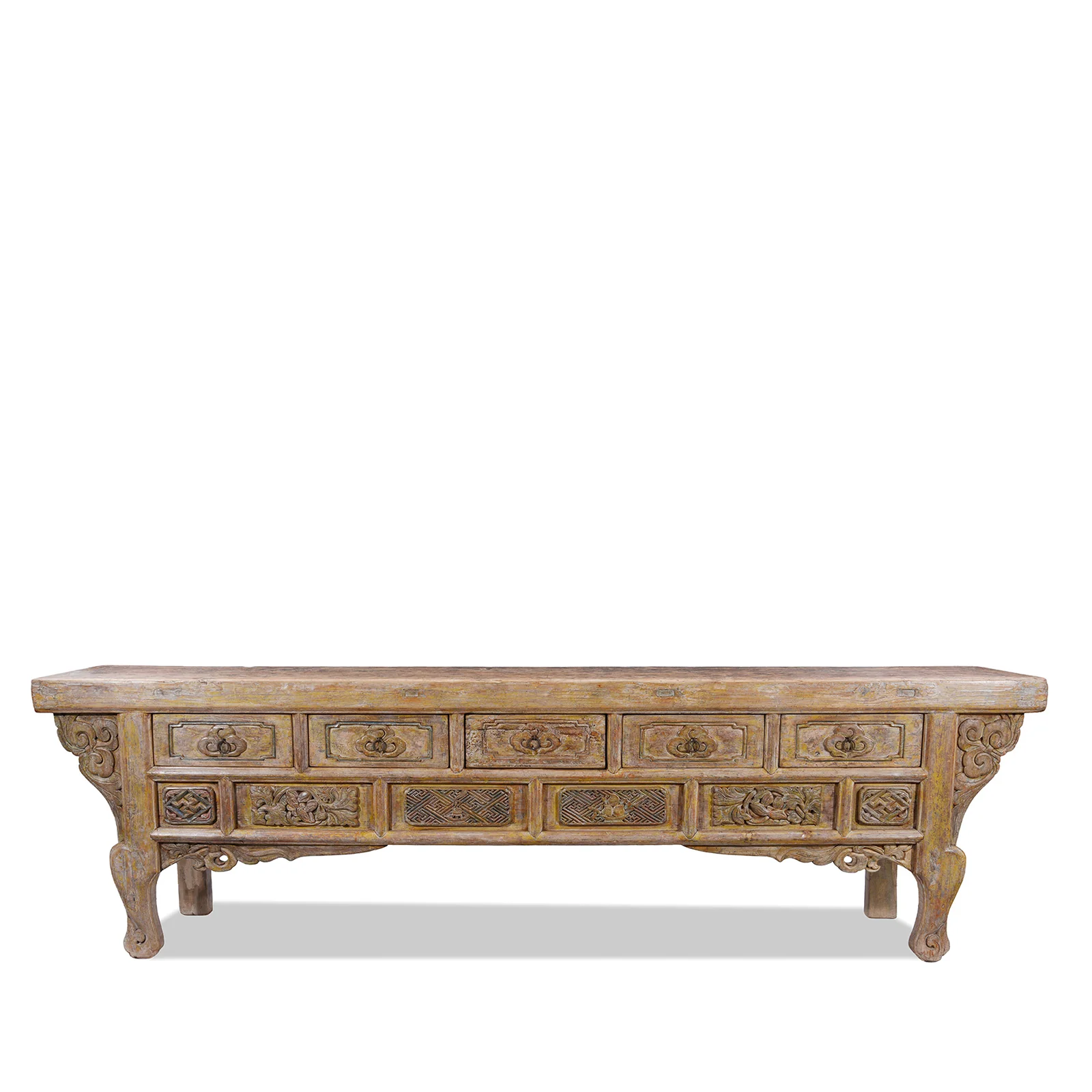
Long Shanxi Altar Table - Early 19th Century
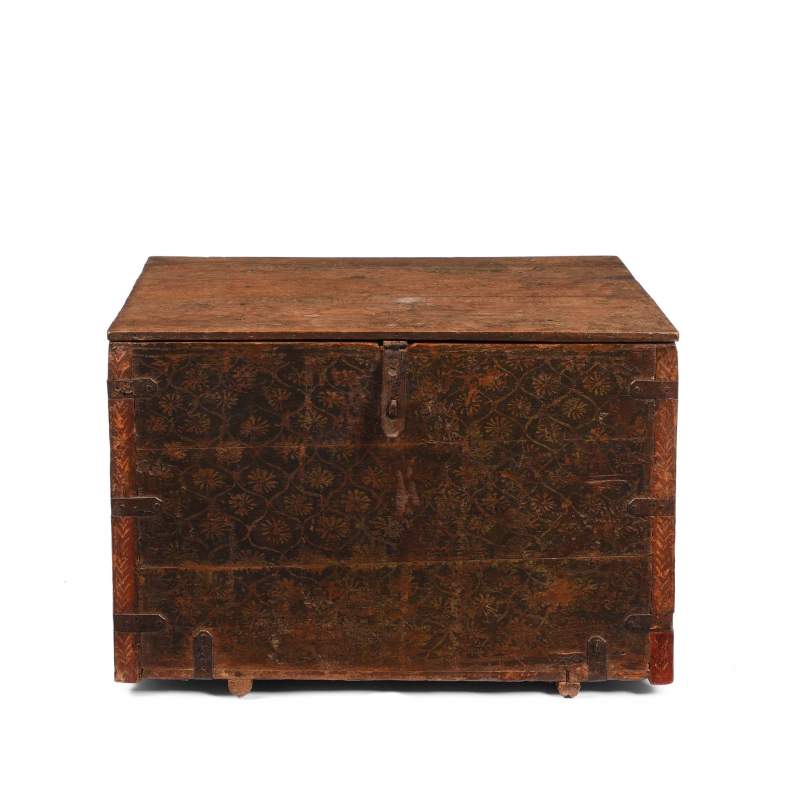
This monumental long altar table originates from Shanxi Province in Northern China and dates to the early 19th century, during the Qing dynasty (1644-1911) - tables like this are now rare to find. Altar tables of this scale were not secondary furnishings but formed the ceremonial and visual core of prosperous households, positioned within the main hall to support ancestral tablets, incense burners, ritual vessels, and offerings. In this role, the table functioned as both furniture and architecture, anchoring lineage, memory, and moral order within the domestic space.
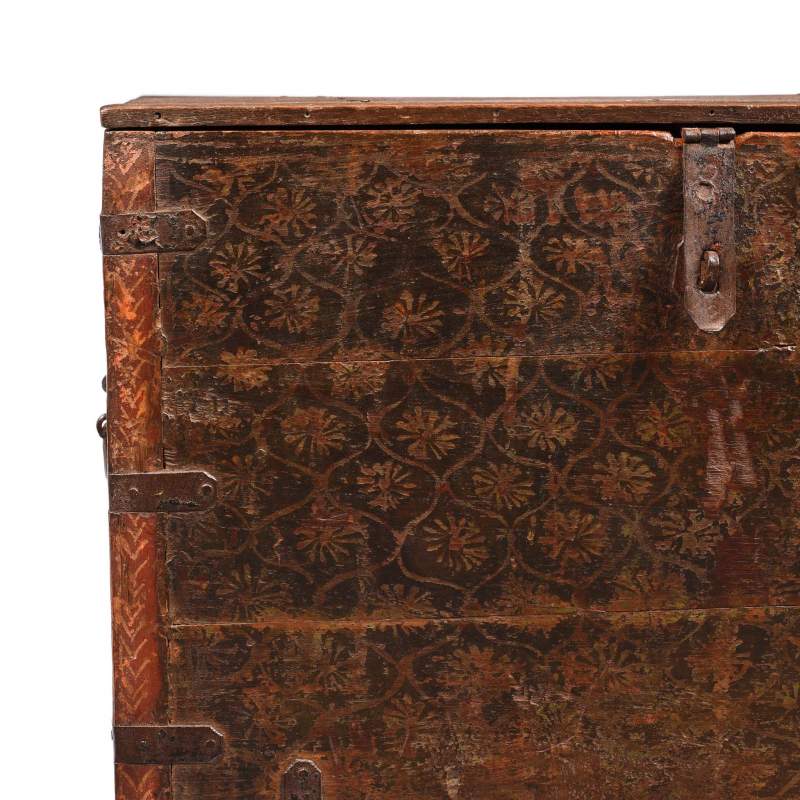
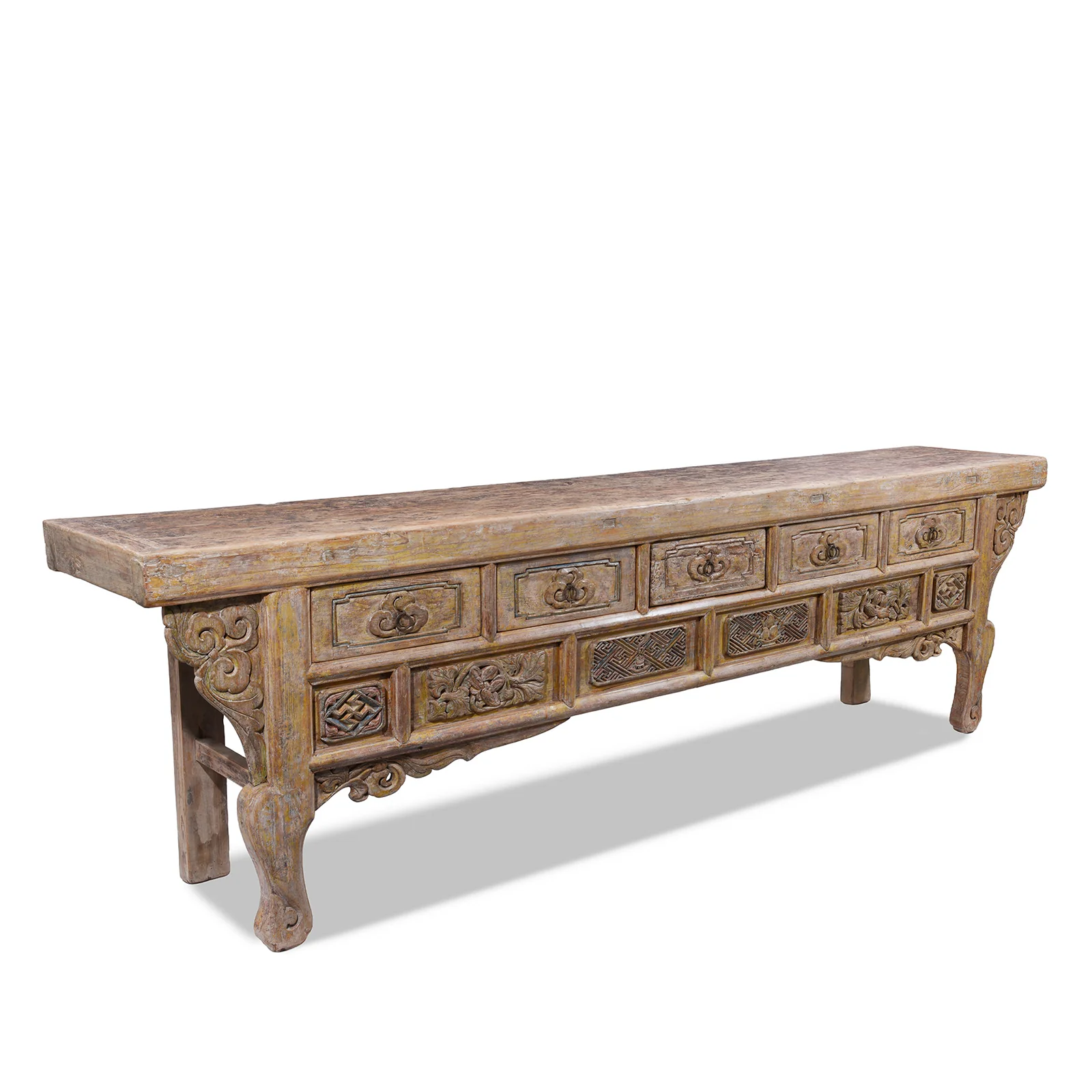
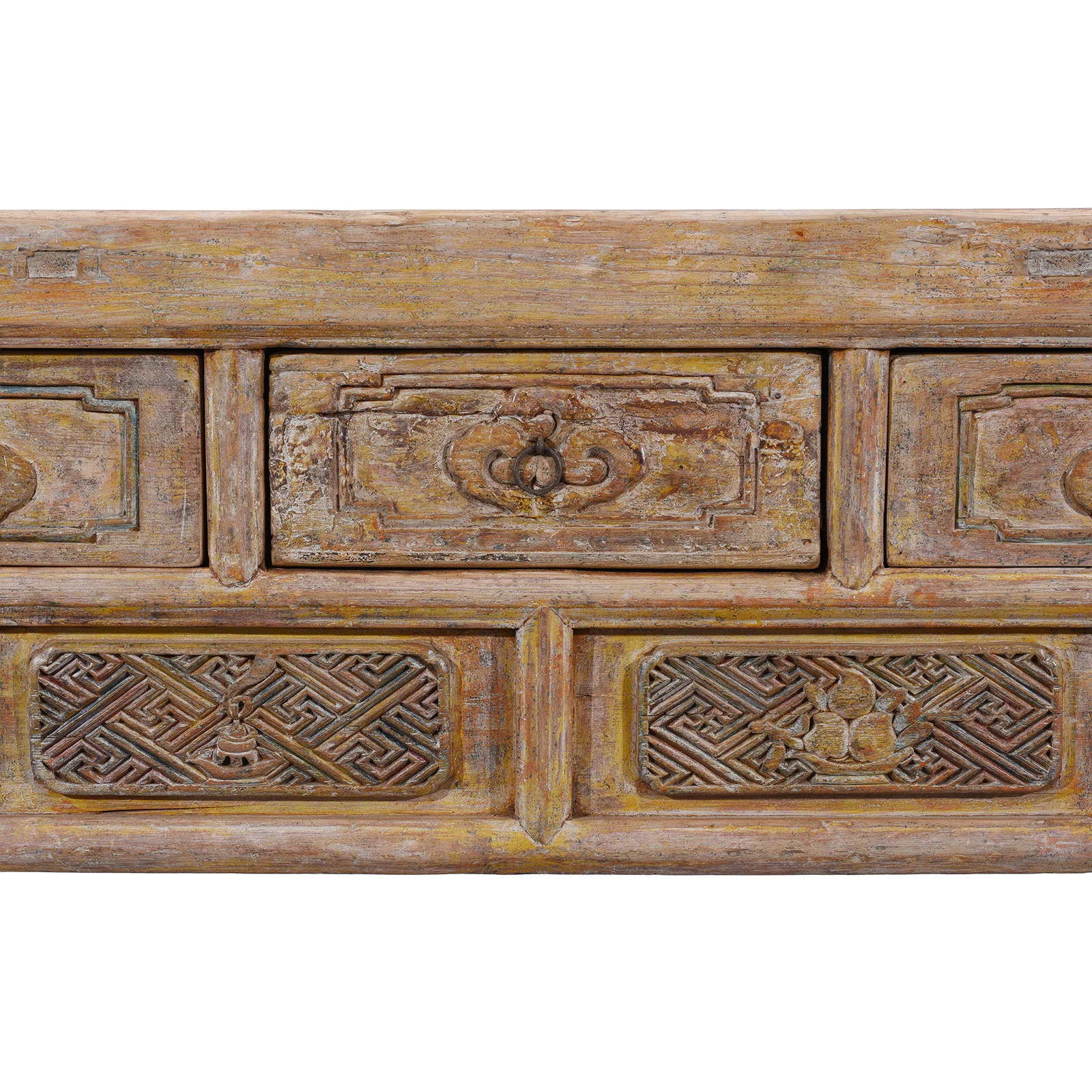
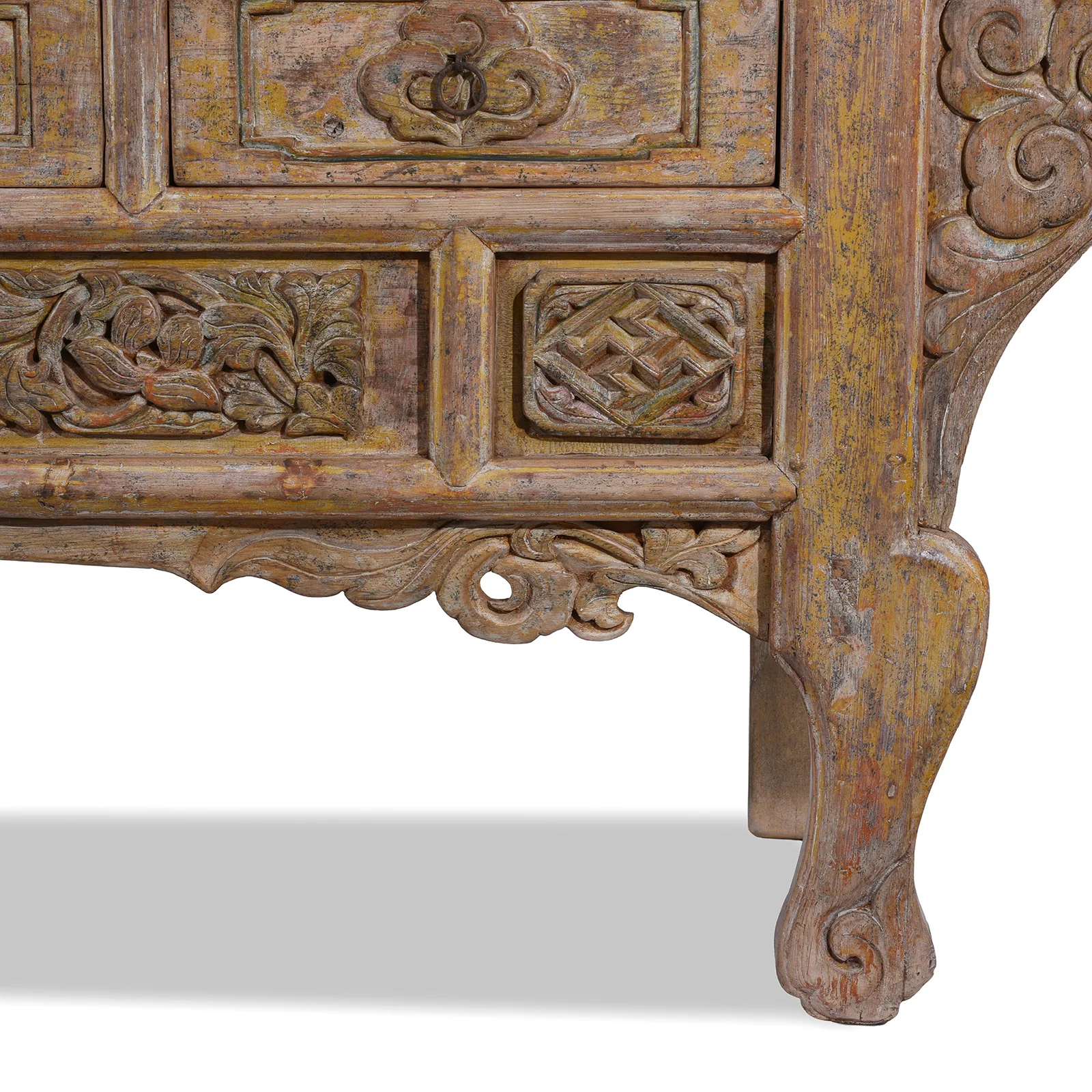
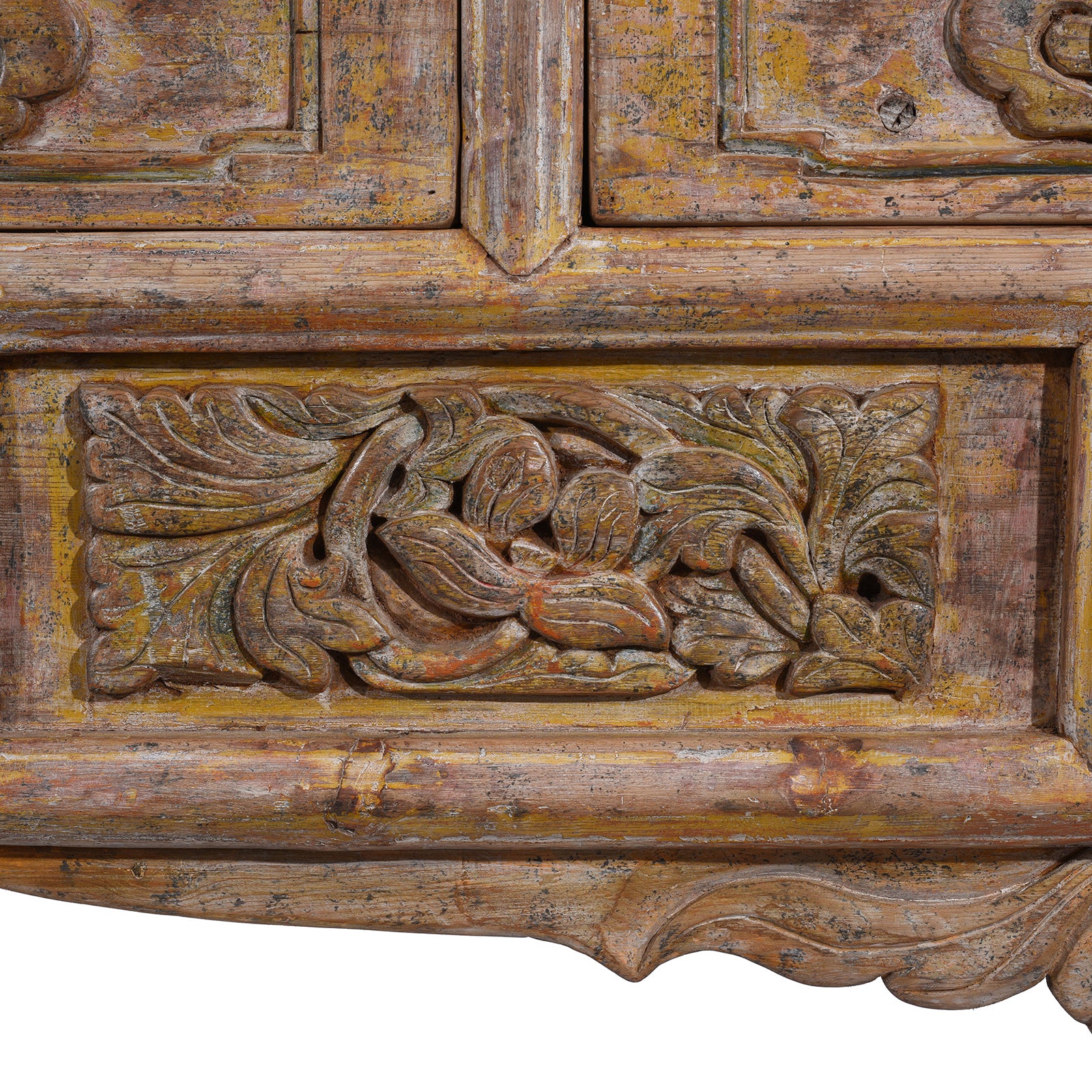
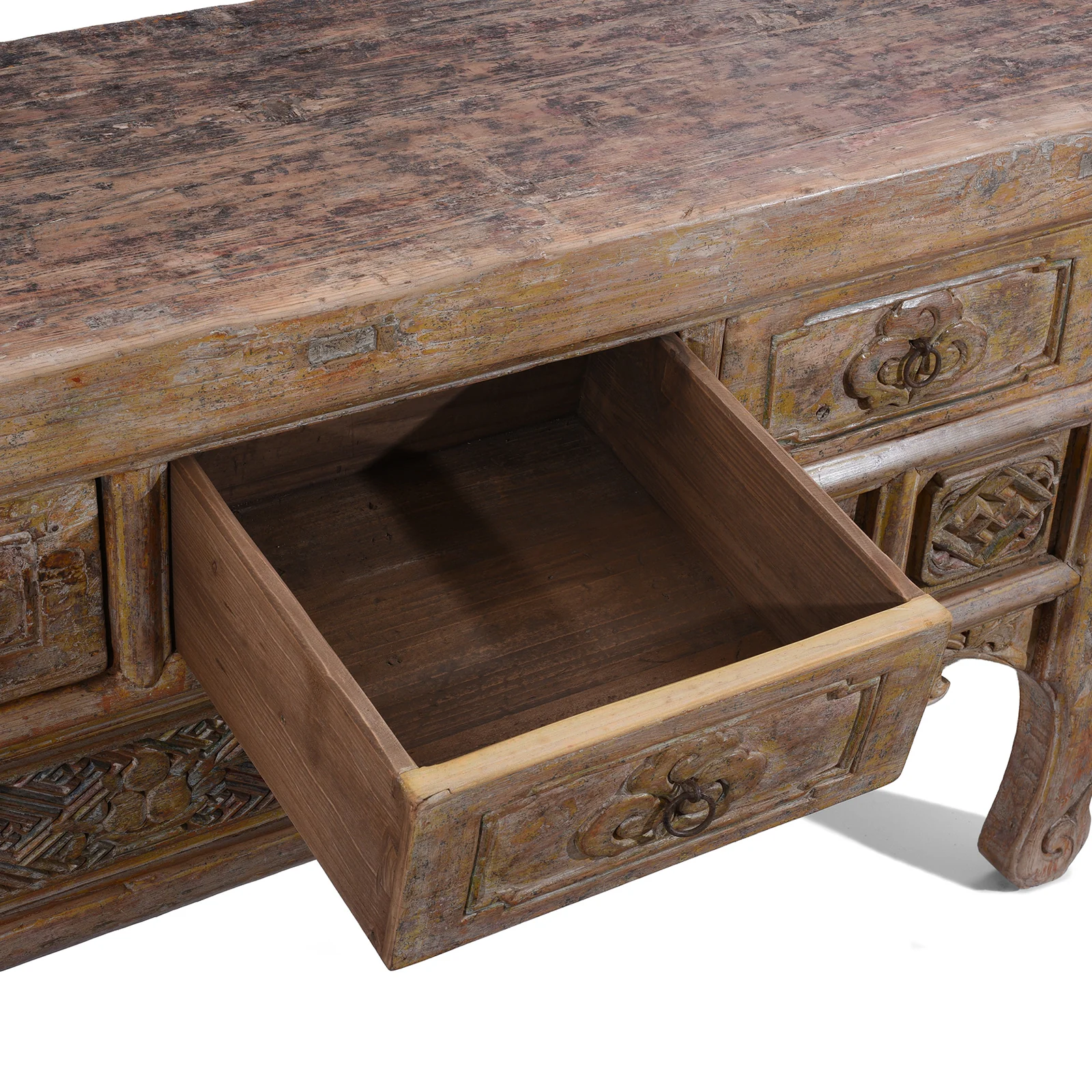
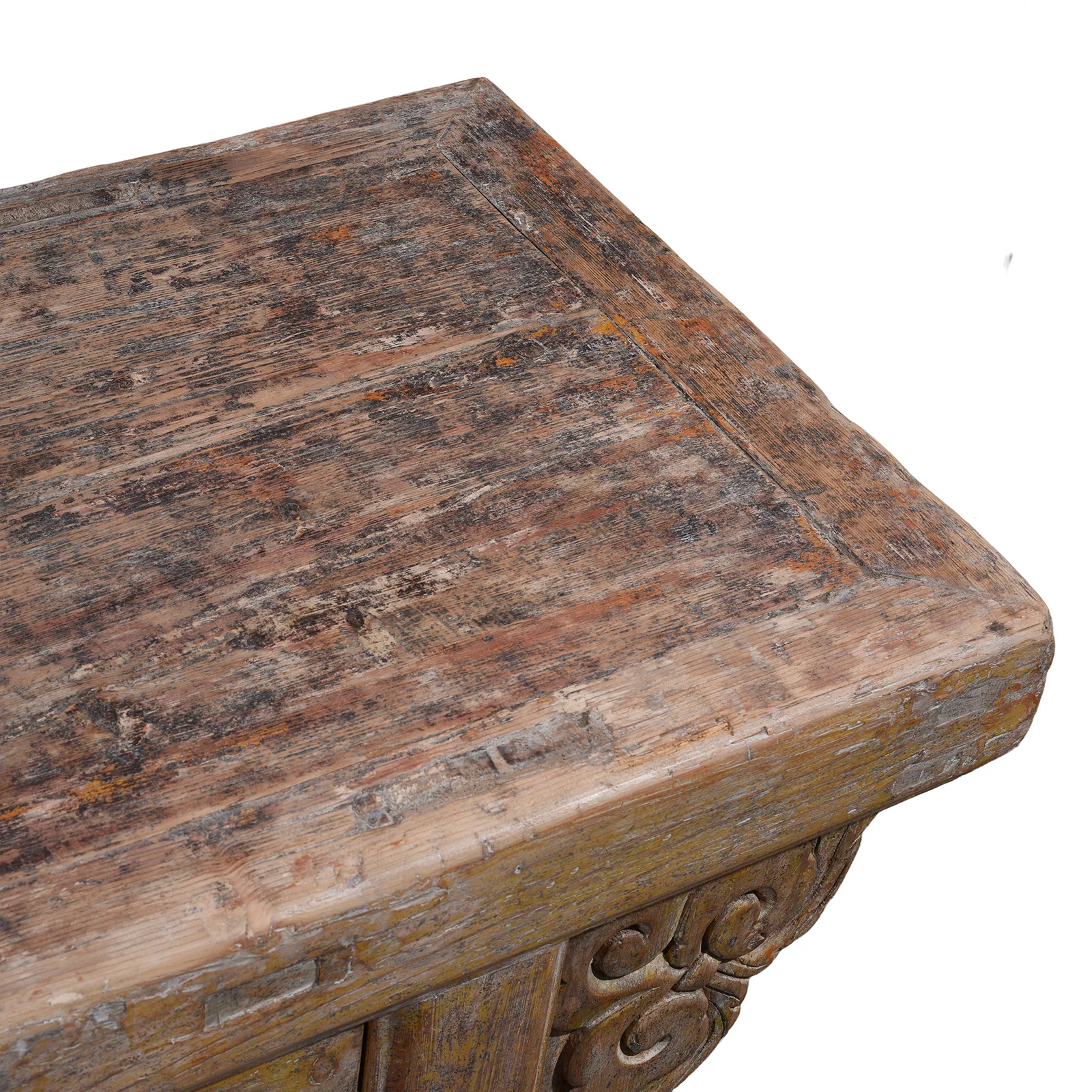
Constructed from pine (松木 songmu) and elm (榆木 yumu), the table is distinguished by a richly carved façade animated with symbolic imagery rather than applied ornament. Prominent among the motifs is the myrobalan fruit, traditionally associated with health, longevity, and renewal, alongside a carved censer, representing ritual practice and the mediation between the earthly and spiritual realms through incense and smoke. Flowing foliate designs weave across the panels, evoking abundance, continuity, and the cyclical vitality of nature.
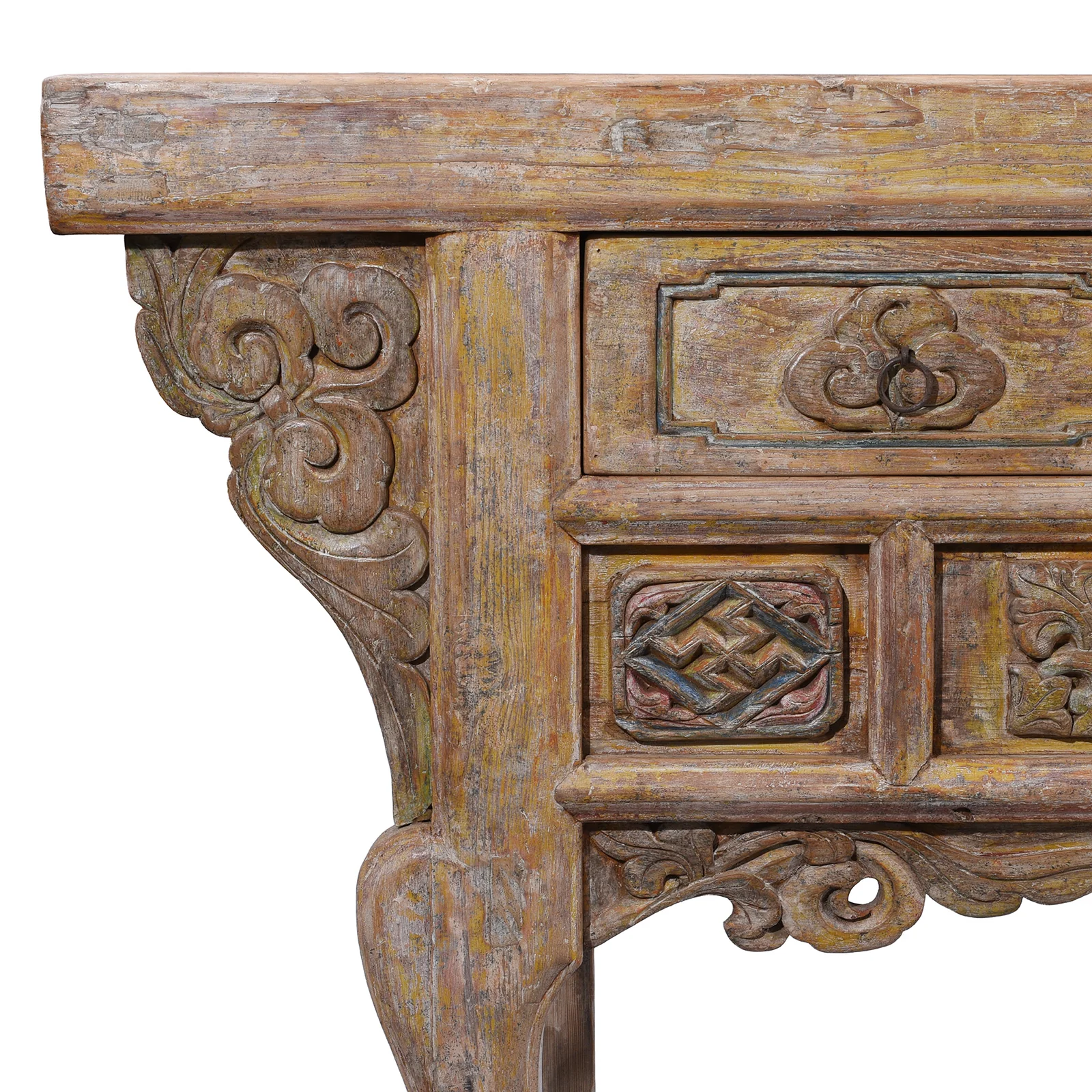
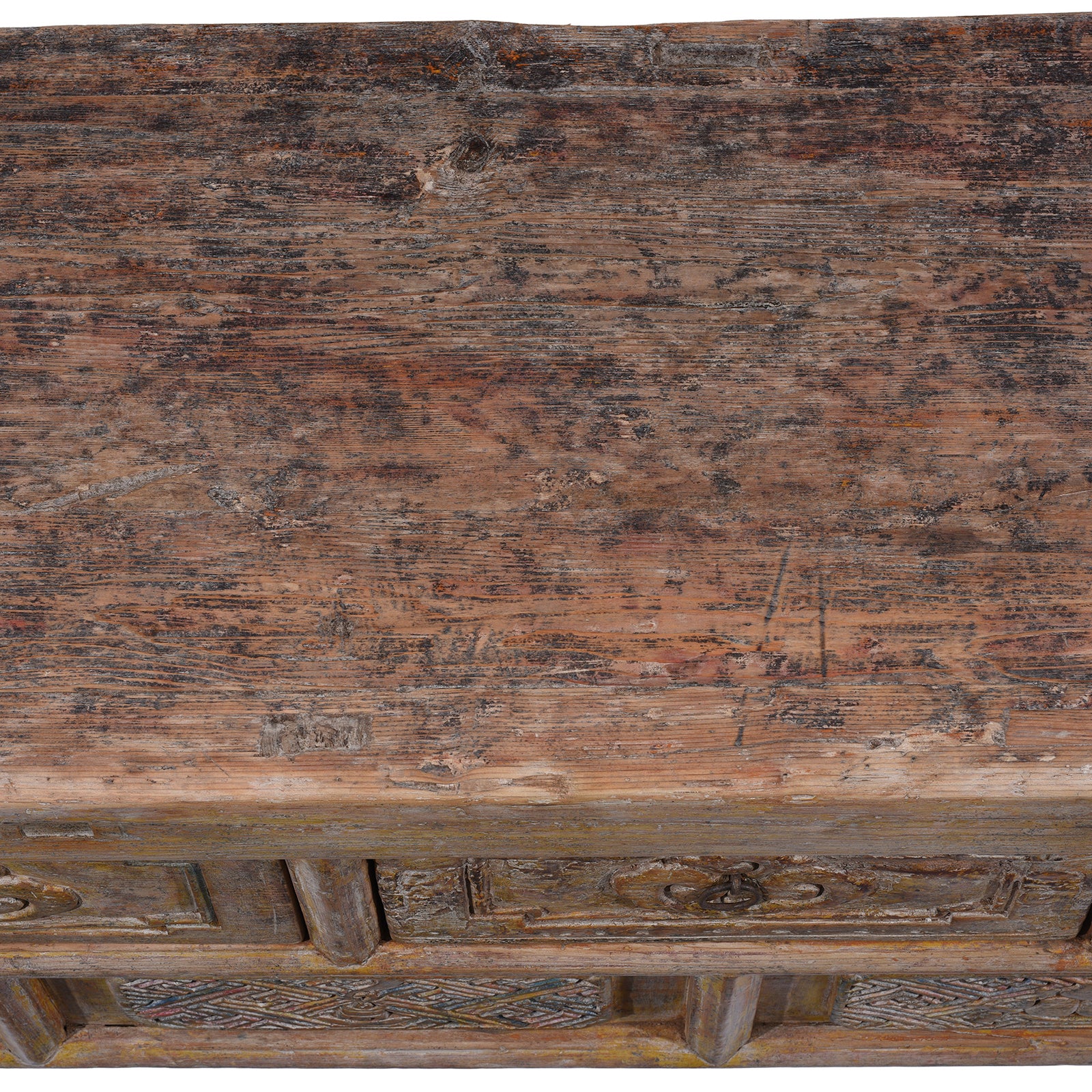
These carvings are framed by repeating swastika motifs, an ancient auspicious symbol in East Asia signifying eternity, balance, and the unbroken circulation of good fortune. In Shanxi furniture of this type, such borders serve both a symbolic and architectural function, containing and protecting the imagery within while reinforcing the table’s formal symmetry.
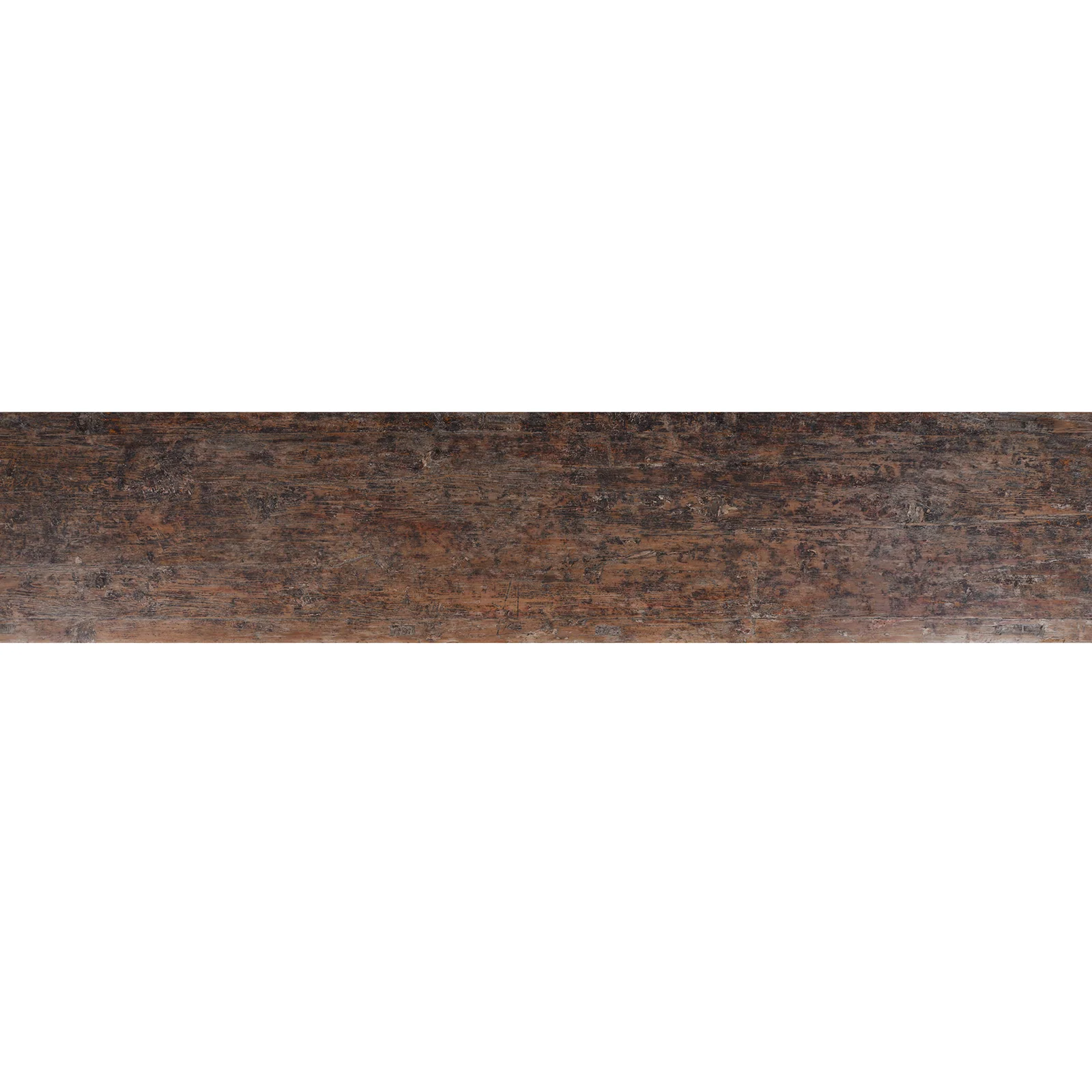
Remnants of the painted surface survives with a softly weathered patina, its muted tones bearing the quiet evidence of sustained use. The deeply carved cabriole legs, terminating in hoof-shaped feet, are a defining regional feature of Shanxi altar furniture, lending the table a sense of lift and architectural poise while visually balancing its considerable mass. Comparable leg forms, apron carving, and overall proportions are illustrated in documented Shanxi examples of altar tables from the Qing period.
Originally, the upper section was formed of fixed panels rather than drawers. These were later converted into drawers, a practical adaptation reflecting the evolving domestic life of the piece rather than modern intervention, and one that has been carried out without disrupting the table’s original rhythm or proportions. Such alterations are not uncommon in large altar tables that remained in use across generations.
Today, the table retains its ceremonial gravity while offering remarkable versatility. Whether placed as a commanding console in a large hallway, used as a dramatic sideboard, or allowed to stand alone as an architectural focal point, it brings with it a rare combination of scale, symbolism, and emotional presence.
- Origin: Shanxi Province, Northern China
- Date: Early 19th century, Qing dynasty
- Materials: Pine (松木 songmu) and elm (榆木 yumu)
- Decoration: Deeply carved panels featuring myrobalan fruit, censer imagery, foliate designs, and auspicious swastika borders
- Later Adaptations: Fixed upper panels later converted to drawers
- Condition: Structurally sound with surface wear, paint loss, and patina consistent with age and use. Restored in our UK workshops.
- Dimensions: Width 292 × Depth 51 × Height 87 cm
- Origin: Shanxi Province, Northern China
- Date: Early 19th century, Qing dynasty
- Materials: Pine (松木 songmu) and elm (榆木 yumu)
- Decoration: Deeply carved panels featuring myrobalan fruit, censer imagery, foliate designs, and auspicious carved borders
- Later Adaptations: Fixed upper panels converted to drawers
- Condition: Structurally sound with surface wear, paint loss, and patina consistent with age and use. Restored in our UK workshops.
- Dimensions: Width 292 × Depth 51 × Height 87 cm
References:
For similar examples and further reading:
-
Friends of the House: Furniture from China, by Curtis Evarts and Clarence Shangraw.
Fig. 35. -
The C. L. Ma Collection: Traditional Chinese Furniture From The Greater Shanxi Region.
Fig. 54.
Original: $7,648.37
-65%$7,648.37
$2,676.93More Images
Long Shanxi Altar Table - Early 19th Century
This monumental long altar table originates from Shanxi Province in Northern China and dates to the early 19th century, during the Qing dynasty (1644-1911) - tables like this are now rare to find. Altar tables of this scale were not secondary furnishings but formed the ceremonial and visual core of prosperous households, positioned within the main hall to support ancestral tablets, incense burners, ritual vessels, and offerings. In this role, the table functioned as both furniture and architecture, anchoring lineage, memory, and moral order within the domestic space.
Constructed from pine (松木 songmu) and elm (榆木 yumu), the table is distinguished by a richly carved façade animated with symbolic imagery rather than applied ornament. Prominent among the motifs is the myrobalan fruit, traditionally associated with health, longevity, and renewal, alongside a carved censer, representing ritual practice and the mediation between the earthly and spiritual realms through incense and smoke. Flowing foliate designs weave across the panels, evoking abundance, continuity, and the cyclical vitality of nature.
These carvings are framed by repeating swastika motifs, an ancient auspicious symbol in East Asia signifying eternity, balance, and the unbroken circulation of good fortune. In Shanxi furniture of this type, such borders serve both a symbolic and architectural function, containing and protecting the imagery within while reinforcing the table’s formal symmetry.
Remnants of the painted surface survives with a softly weathered patina, its muted tones bearing the quiet evidence of sustained use. The deeply carved cabriole legs, terminating in hoof-shaped feet, are a defining regional feature of Shanxi altar furniture, lending the table a sense of lift and architectural poise while visually balancing its considerable mass. Comparable leg forms, apron carving, and overall proportions are illustrated in documented Shanxi examples of altar tables from the Qing period.
Originally, the upper section was formed of fixed panels rather than drawers. These were later converted into drawers, a practical adaptation reflecting the evolving domestic life of the piece rather than modern intervention, and one that has been carried out without disrupting the table’s original rhythm or proportions. Such alterations are not uncommon in large altar tables that remained in use across generations.
Today, the table retains its ceremonial gravity while offering remarkable versatility. Whether placed as a commanding console in a large hallway, used as a dramatic sideboard, or allowed to stand alone as an architectural focal point, it brings with it a rare combination of scale, symbolism, and emotional presence.
- Origin: Shanxi Province, Northern China
- Date: Early 19th century, Qing dynasty
- Materials: Pine (松木 songmu) and elm (榆木 yumu)
- Decoration: Deeply carved panels featuring myrobalan fruit, censer imagery, foliate designs, and auspicious swastika borders
- Later Adaptations: Fixed upper panels later converted to drawers
- Condition: Structurally sound with surface wear, paint loss, and patina consistent with age and use. Restored in our UK workshops.
- Dimensions: Width 292 × Depth 51 × Height 87 cm
- Origin: Shanxi Province, Northern China
- Date: Early 19th century, Qing dynasty
- Materials: Pine (松木 songmu) and elm (榆木 yumu)
- Decoration: Deeply carved panels featuring myrobalan fruit, censer imagery, foliate designs, and auspicious carved borders
- Later Adaptations: Fixed upper panels converted to drawers
- Condition: Structurally sound with surface wear, paint loss, and patina consistent with age and use. Restored in our UK workshops.
- Dimensions: Width 292 × Depth 51 × Height 87 cm
References:
For similar examples and further reading:
-
Friends of the House: Furniture from China, by Curtis Evarts and Clarence Shangraw.
Fig. 35. -
The C. L. Ma Collection: Traditional Chinese Furniture From The Greater Shanxi Region.
Fig. 54.
Product Information
Product Information
Shipping & Returns
Shipping & Returns
Description
This monumental long altar table originates from Shanxi Province in Northern China and dates to the early 19th century, during the Qing dynasty (1644-1911) - tables like this are now rare to find. Altar tables of this scale were not secondary furnishings but formed the ceremonial and visual core of prosperous households, positioned within the main hall to support ancestral tablets, incense burners, ritual vessels, and offerings. In this role, the table functioned as both furniture and architecture, anchoring lineage, memory, and moral order within the domestic space.
Constructed from pine (松木 songmu) and elm (榆木 yumu), the table is distinguished by a richly carved façade animated with symbolic imagery rather than applied ornament. Prominent among the motifs is the myrobalan fruit, traditionally associated with health, longevity, and renewal, alongside a carved censer, representing ritual practice and the mediation between the earthly and spiritual realms through incense and smoke. Flowing foliate designs weave across the panels, evoking abundance, continuity, and the cyclical vitality of nature.
These carvings are framed by repeating swastika motifs, an ancient auspicious symbol in East Asia signifying eternity, balance, and the unbroken circulation of good fortune. In Shanxi furniture of this type, such borders serve both a symbolic and architectural function, containing and protecting the imagery within while reinforcing the table’s formal symmetry.
Remnants of the painted surface survives with a softly weathered patina, its muted tones bearing the quiet evidence of sustained use. The deeply carved cabriole legs, terminating in hoof-shaped feet, are a defining regional feature of Shanxi altar furniture, lending the table a sense of lift and architectural poise while visually balancing its considerable mass. Comparable leg forms, apron carving, and overall proportions are illustrated in documented Shanxi examples of altar tables from the Qing period.
Originally, the upper section was formed of fixed panels rather than drawers. These were later converted into drawers, a practical adaptation reflecting the evolving domestic life of the piece rather than modern intervention, and one that has been carried out without disrupting the table’s original rhythm or proportions. Such alterations are not uncommon in large altar tables that remained in use across generations.
Today, the table retains its ceremonial gravity while offering remarkable versatility. Whether placed as a commanding console in a large hallway, used as a dramatic sideboard, or allowed to stand alone as an architectural focal point, it brings with it a rare combination of scale, symbolism, and emotional presence.
- Origin: Shanxi Province, Northern China
- Date: Early 19th century, Qing dynasty
- Materials: Pine (松木 songmu) and elm (榆木 yumu)
- Decoration: Deeply carved panels featuring myrobalan fruit, censer imagery, foliate designs, and auspicious swastika borders
- Later Adaptations: Fixed upper panels later converted to drawers
- Condition: Structurally sound with surface wear, paint loss, and patina consistent with age and use. Restored in our UK workshops.
- Dimensions: Width 292 × Depth 51 × Height 87 cm
- Origin: Shanxi Province, Northern China
- Date: Early 19th century, Qing dynasty
- Materials: Pine (松木 songmu) and elm (榆木 yumu)
- Decoration: Deeply carved panels featuring myrobalan fruit, censer imagery, foliate designs, and auspicious carved borders
- Later Adaptations: Fixed upper panels converted to drawers
- Condition: Structurally sound with surface wear, paint loss, and patina consistent with age and use. Restored in our UK workshops.
- Dimensions: Width 292 × Depth 51 × Height 87 cm
References:
For similar examples and further reading:
-
Friends of the House: Furniture from China, by Curtis Evarts and Clarence Shangraw.
Fig. 35. -
The C. L. Ma Collection: Traditional Chinese Furniture From The Greater Shanxi Region.
Fig. 54.