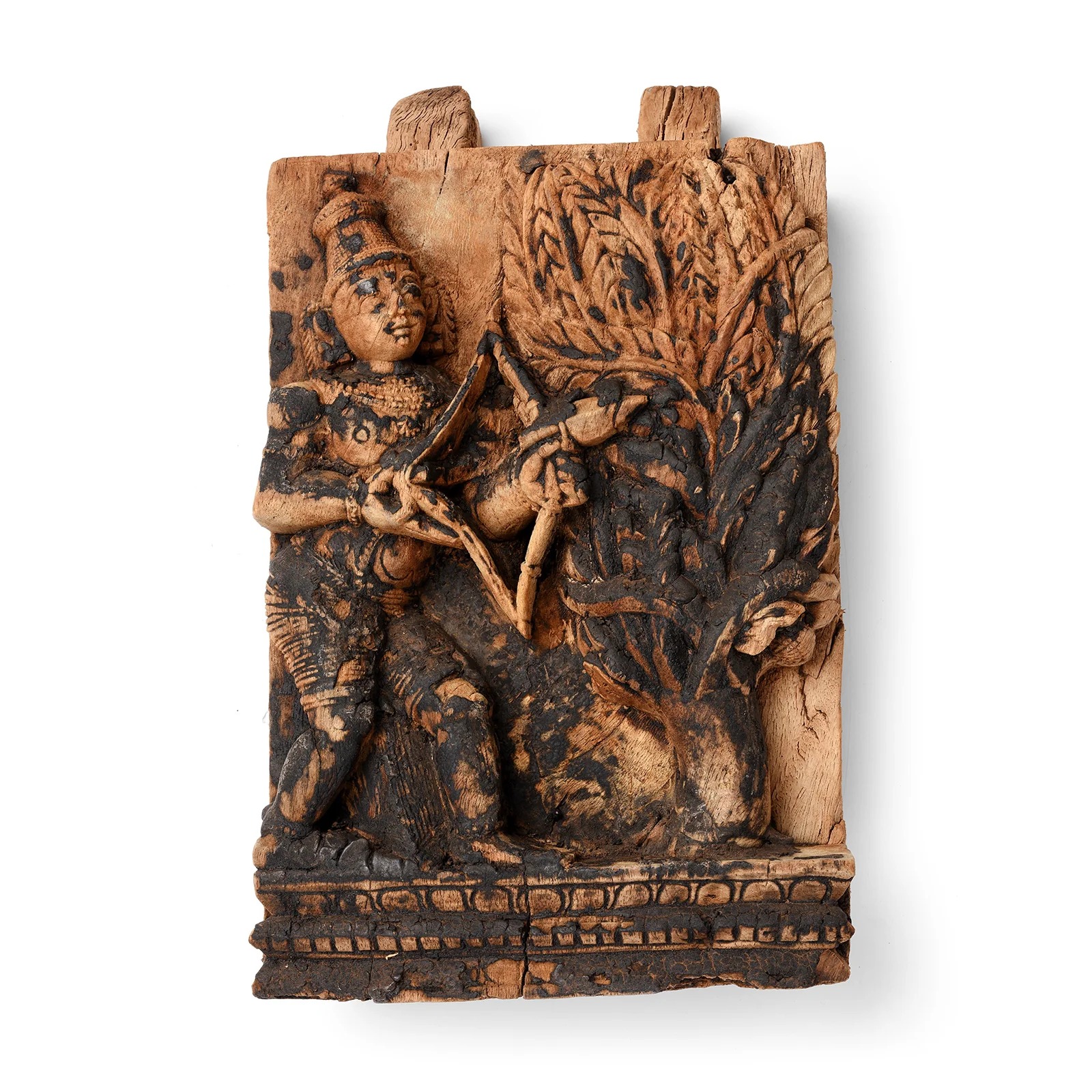
Carved Teak Chariot Carving Of Lord Rama - 19th Century
This carved teak chariot panel depicting Lord Rama is from an old temple chariot from Tamil Nadu in South India. Lord Rama is associated with virtue and was believed to be an incarnation of Vishnu. Rama is seen here wearing a Kiritamukuta, 'The Highest of All Crowns' holding a bow. This is likely a scene from The Ramayana, an ancient Hindu epic written in Sanskrit, specifically the tale of Vali & Sugriva.
Vali & Sugriva were brothers and when Sugriva mistakenly believed his brother to be dead, he assumed the throne of Kishkindha. Vali eventually returned and took back his throne enslaving Sugriva's wife and banishing him. Lord Rama took pity on Sugriva and advised him to challenge his brother to a dual. The first dual fails as Rama cannot differentiate between the two brothers, but during a rematch, Rama shoots an arrow piercing Vali's heart and killing him.
The chariots (also known as Ratha Yatra) were decorated with carved teak images - mostly of religious significance. They are enormous temples on wheels drawn through the streets by hundreds of people.
From India
UK Delivery Charge - except Highlands & Islands £15
More delivery options available at checkout
Original: $1,120.82
-65%$1,120.82
$392.29More Images

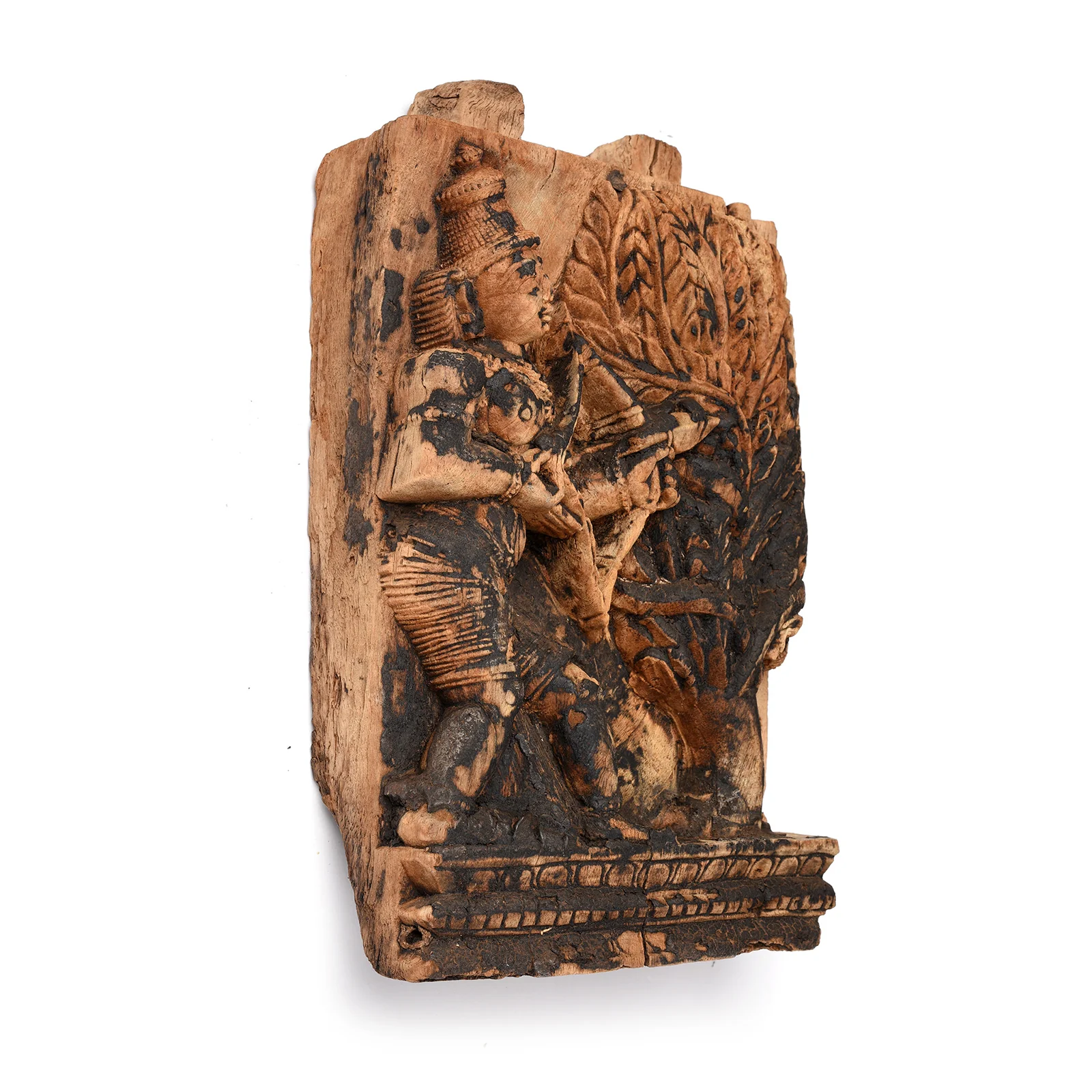

Carved Teak Chariot Carving Of Lord Rama - 19th Century
This carved teak chariot panel depicting Lord Rama is from an old temple chariot from Tamil Nadu in South India. Lord Rama is associated with virtue and was believed to be an incarnation of Vishnu. Rama is seen here wearing a Kiritamukuta, 'The Highest of All Crowns' holding a bow. This is likely a scene from The Ramayana, an ancient Hindu epic written in Sanskrit, specifically the tale of Vali & Sugriva.
Vali & Sugriva were brothers and when Sugriva mistakenly believed his brother to be dead, he assumed the throne of Kishkindha. Vali eventually returned and took back his throne enslaving Sugriva's wife and banishing him. Lord Rama took pity on Sugriva and advised him to challenge his brother to a dual. The first dual fails as Rama cannot differentiate between the two brothers, but during a rematch, Rama shoots an arrow piercing Vali's heart and killing him.
The chariots (also known as Ratha Yatra) were decorated with carved teak images - mostly of religious significance. They are enormous temples on wheels drawn through the streets by hundreds of people.
From India
UK Delivery Charge - except Highlands & Islands £15
More delivery options available at checkout
Product Information
Product Information
Shipping & Returns
Shipping & Returns
Description
This carved teak chariot panel depicting Lord Rama is from an old temple chariot from Tamil Nadu in South India. Lord Rama is associated with virtue and was believed to be an incarnation of Vishnu. Rama is seen here wearing a Kiritamukuta, 'The Highest of All Crowns' holding a bow. This is likely a scene from The Ramayana, an ancient Hindu epic written in Sanskrit, specifically the tale of Vali & Sugriva.
Vali & Sugriva were brothers and when Sugriva mistakenly believed his brother to be dead, he assumed the throne of Kishkindha. Vali eventually returned and took back his throne enslaving Sugriva's wife and banishing him. Lord Rama took pity on Sugriva and advised him to challenge his brother to a dual. The first dual fails as Rama cannot differentiate between the two brothers, but during a rematch, Rama shoots an arrow piercing Vali's heart and killing him.
The chariots (also known as Ratha Yatra) were decorated with carved teak images - mostly of religious significance. They are enormous temples on wheels drawn through the streets by hundreds of people.
From India
UK Delivery Charge - except Highlands & Islands £15
More delivery options available at checkout