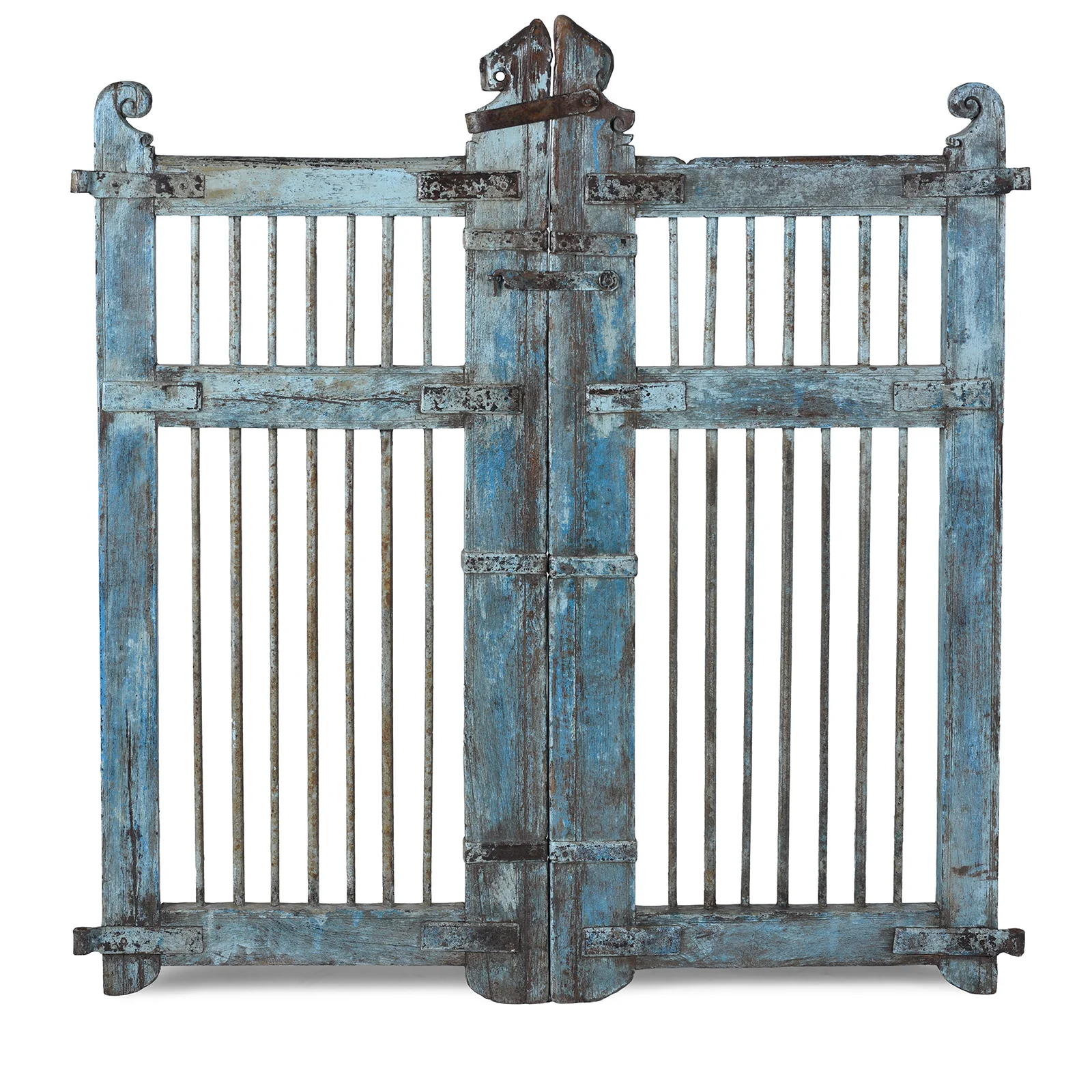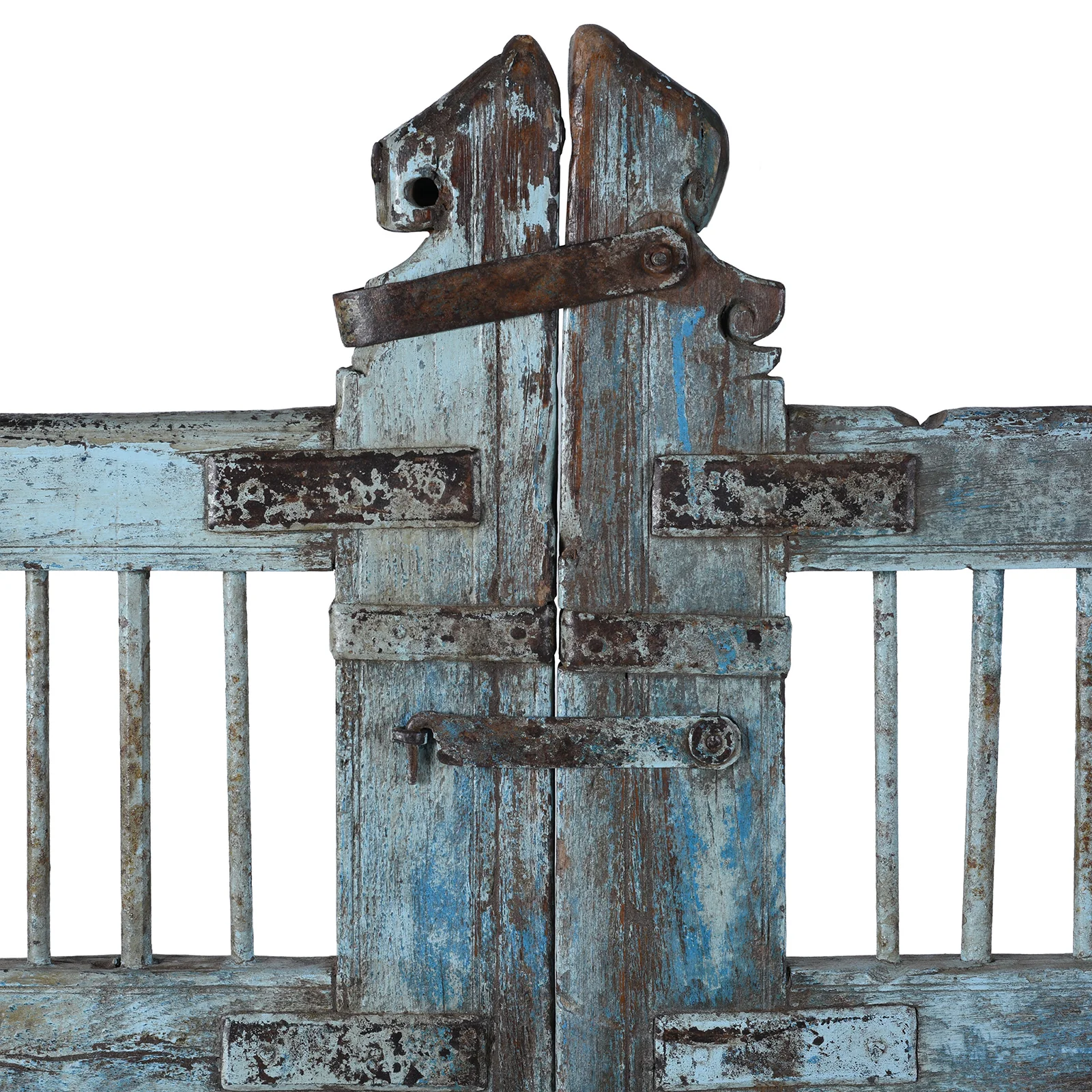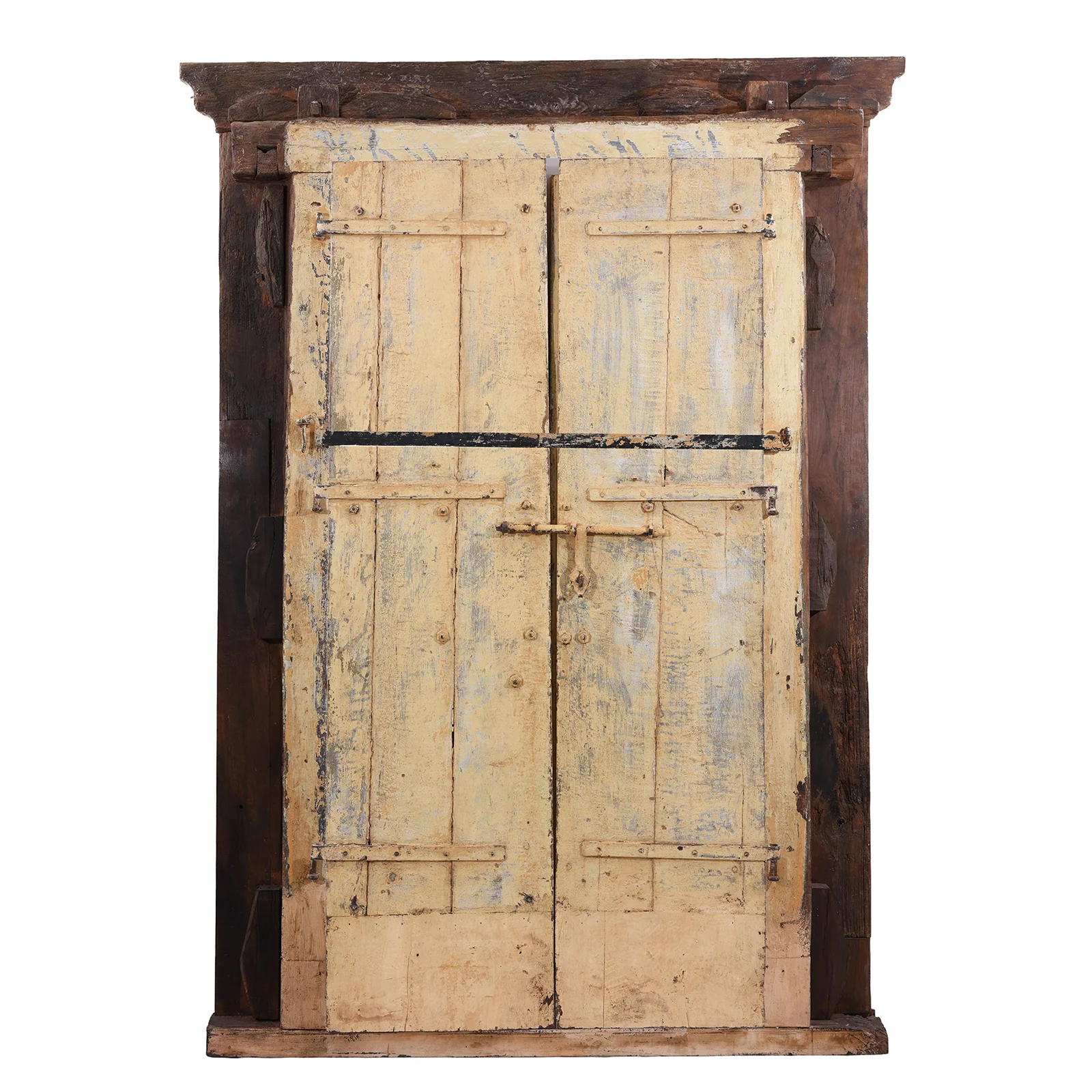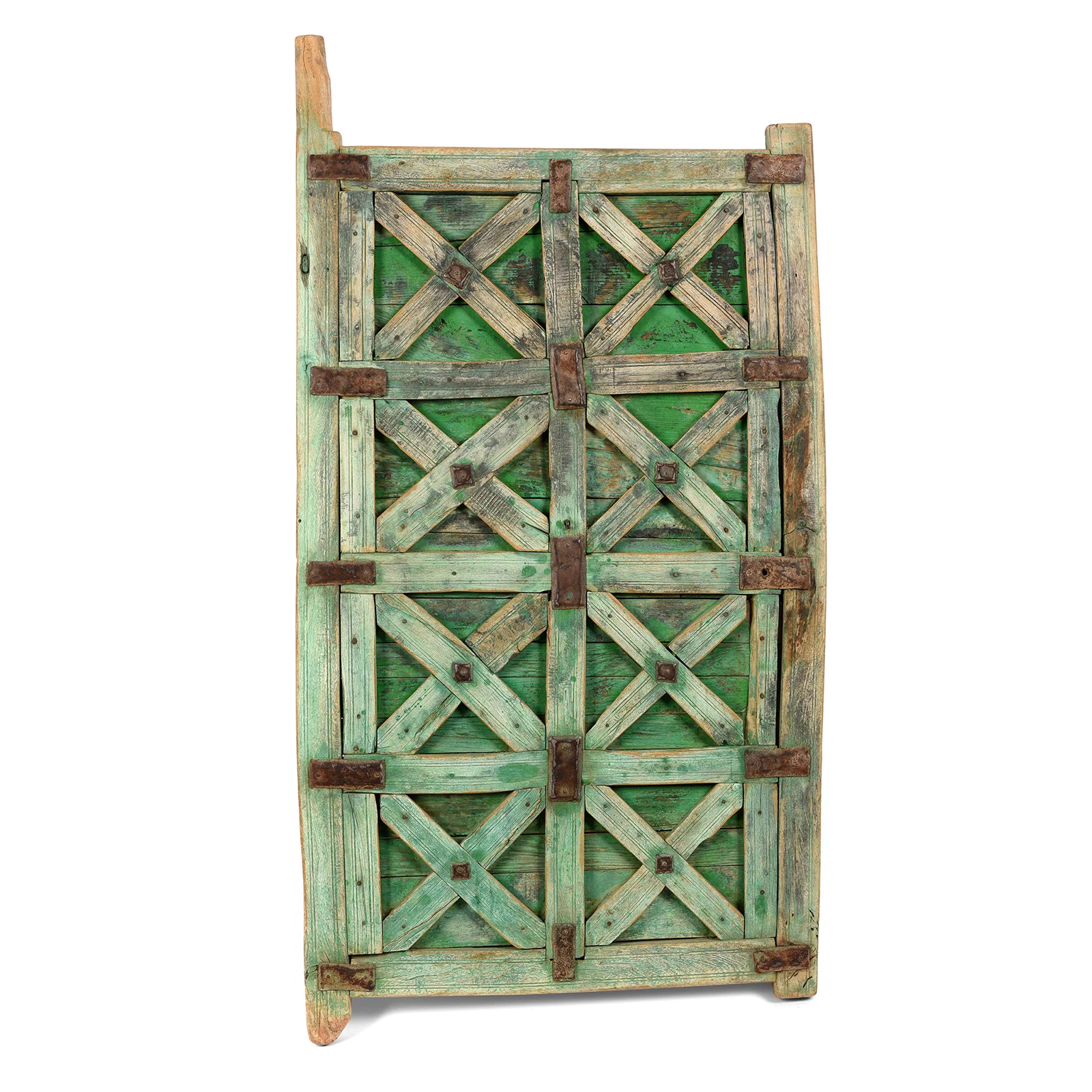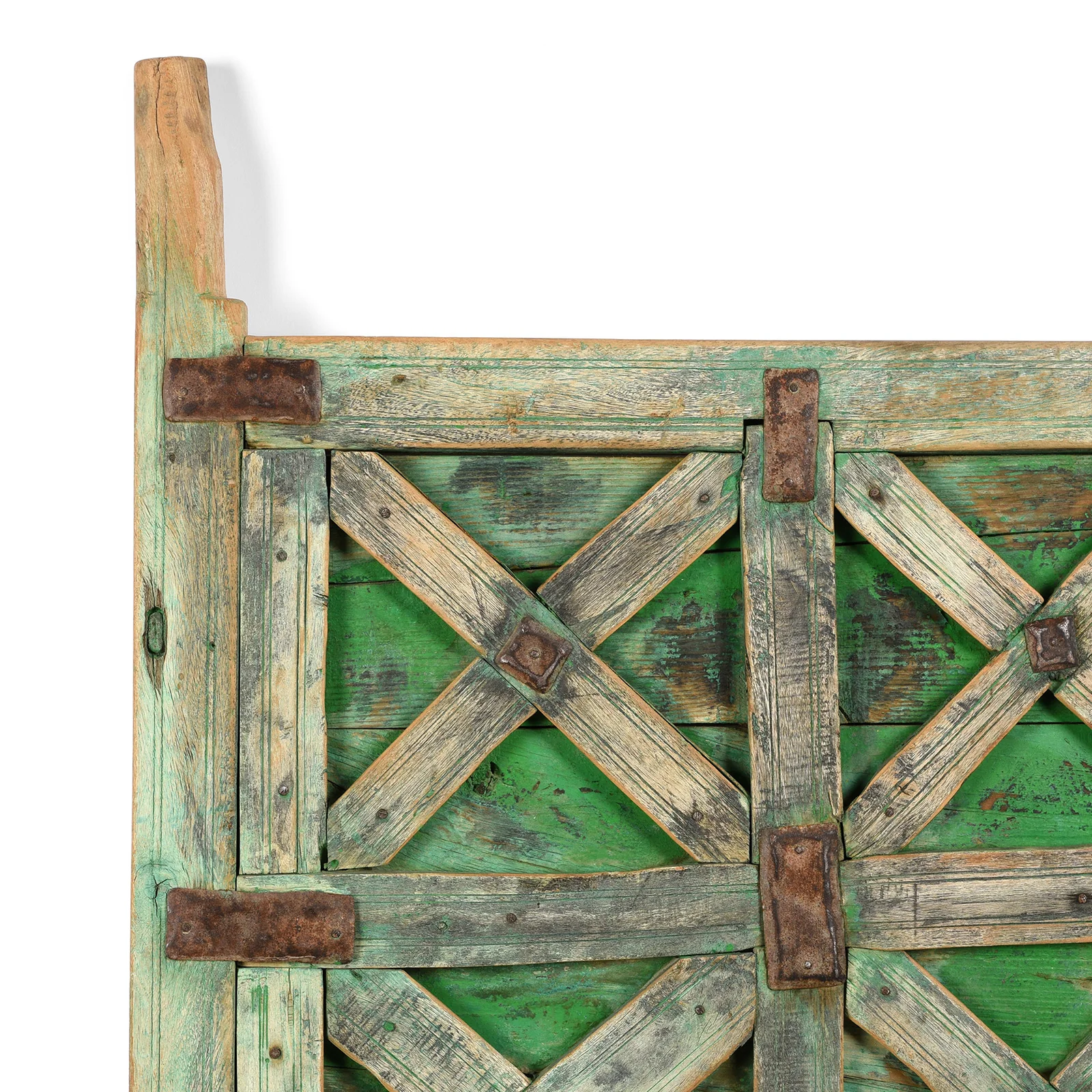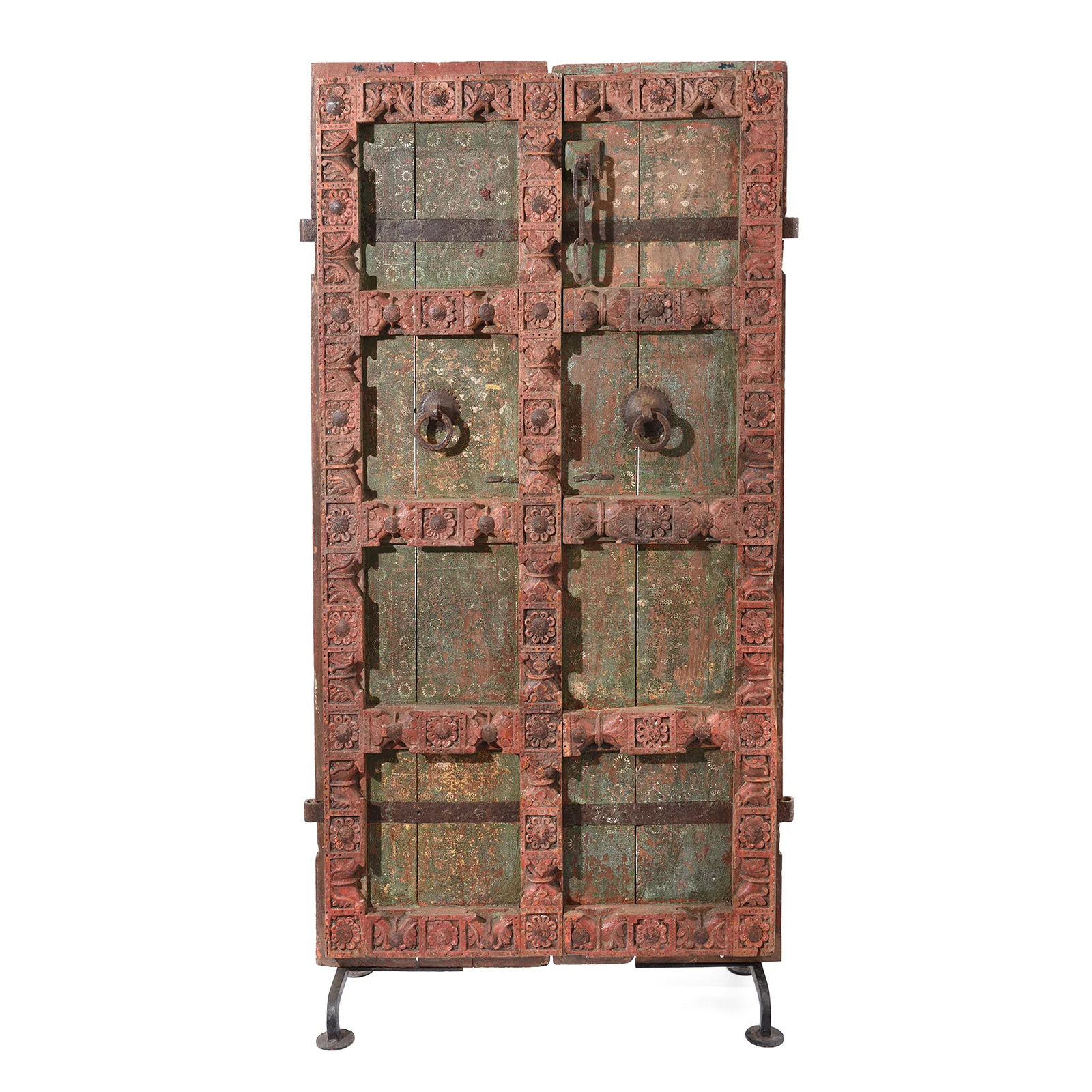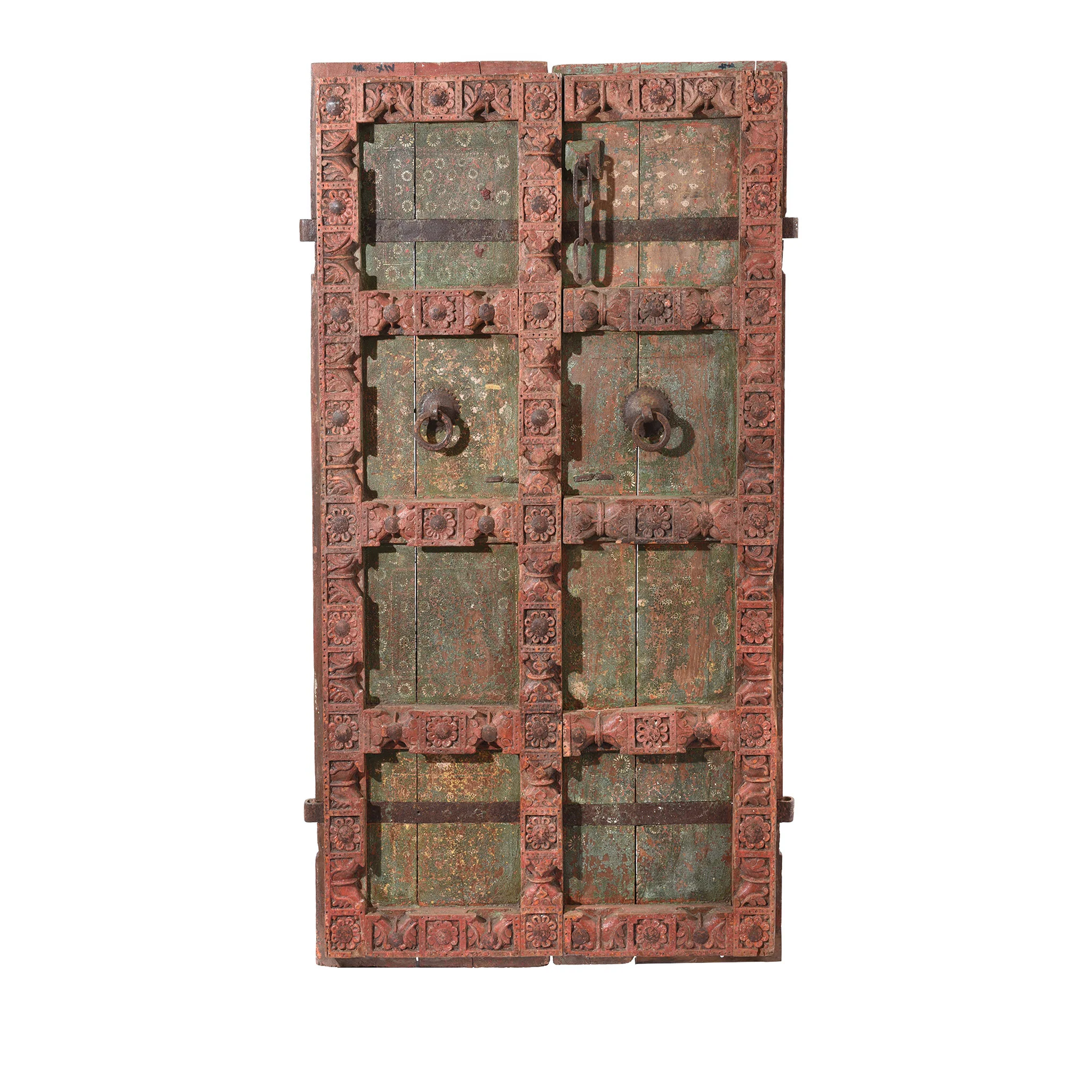
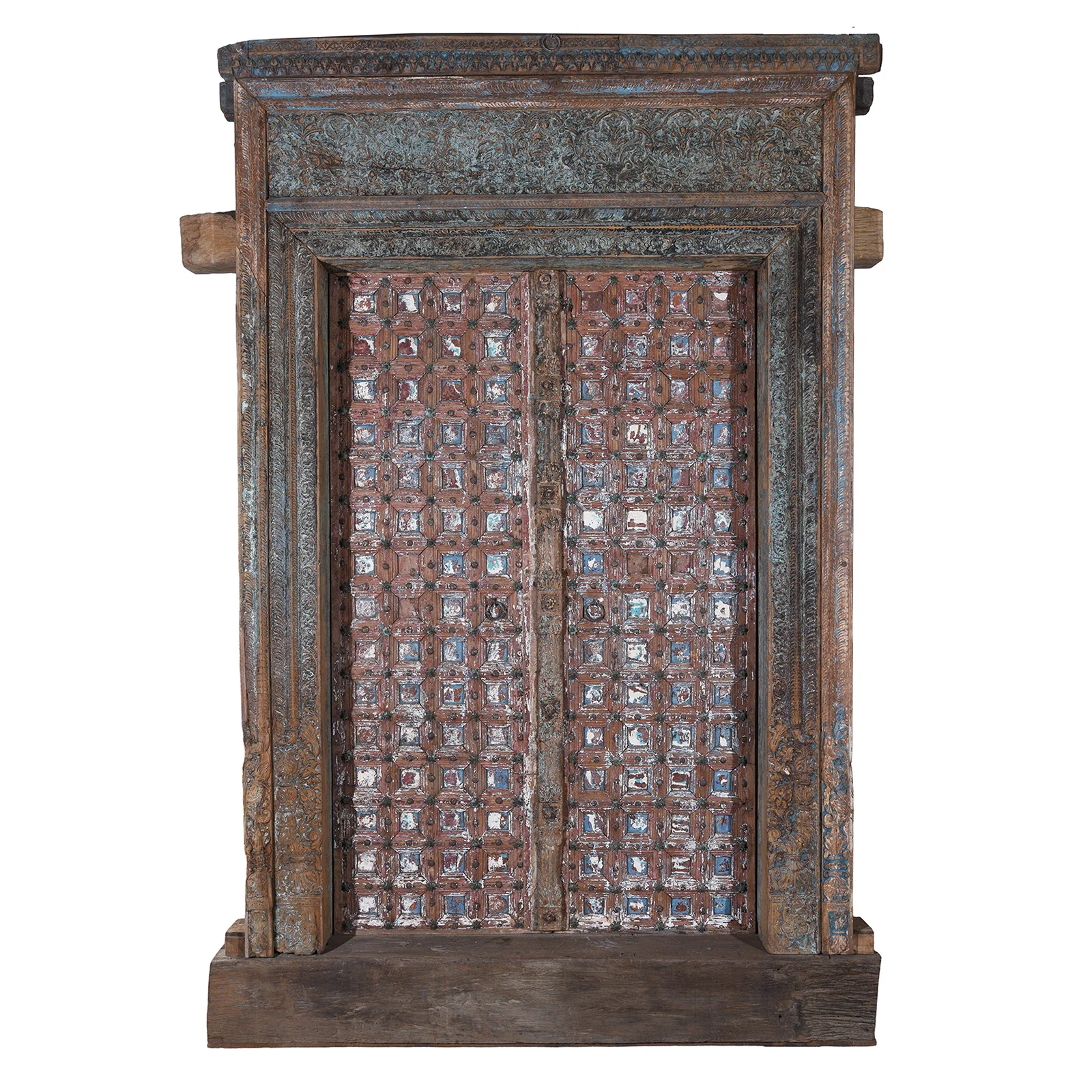
Painted & Carved Door From The Punjab - 19th Century
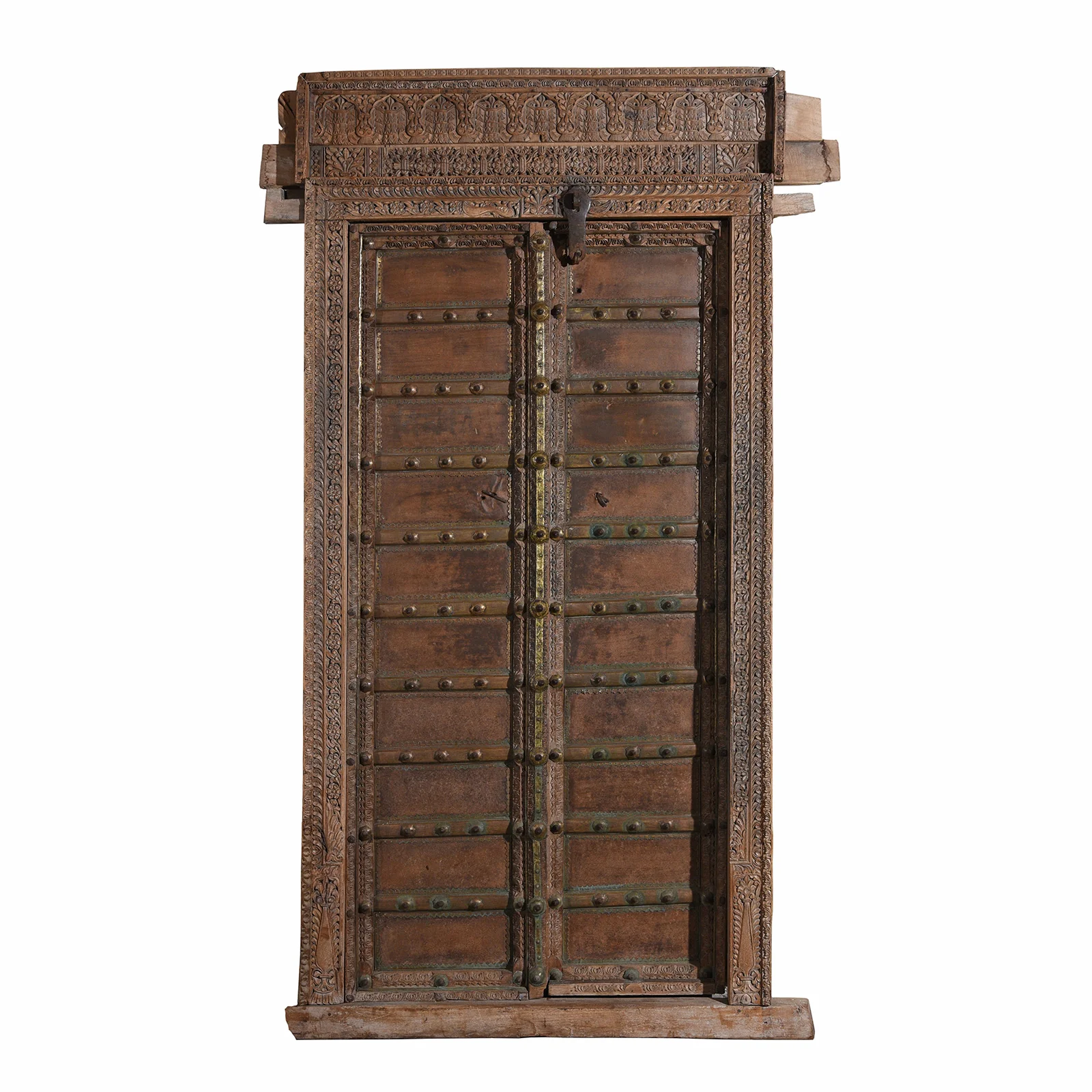
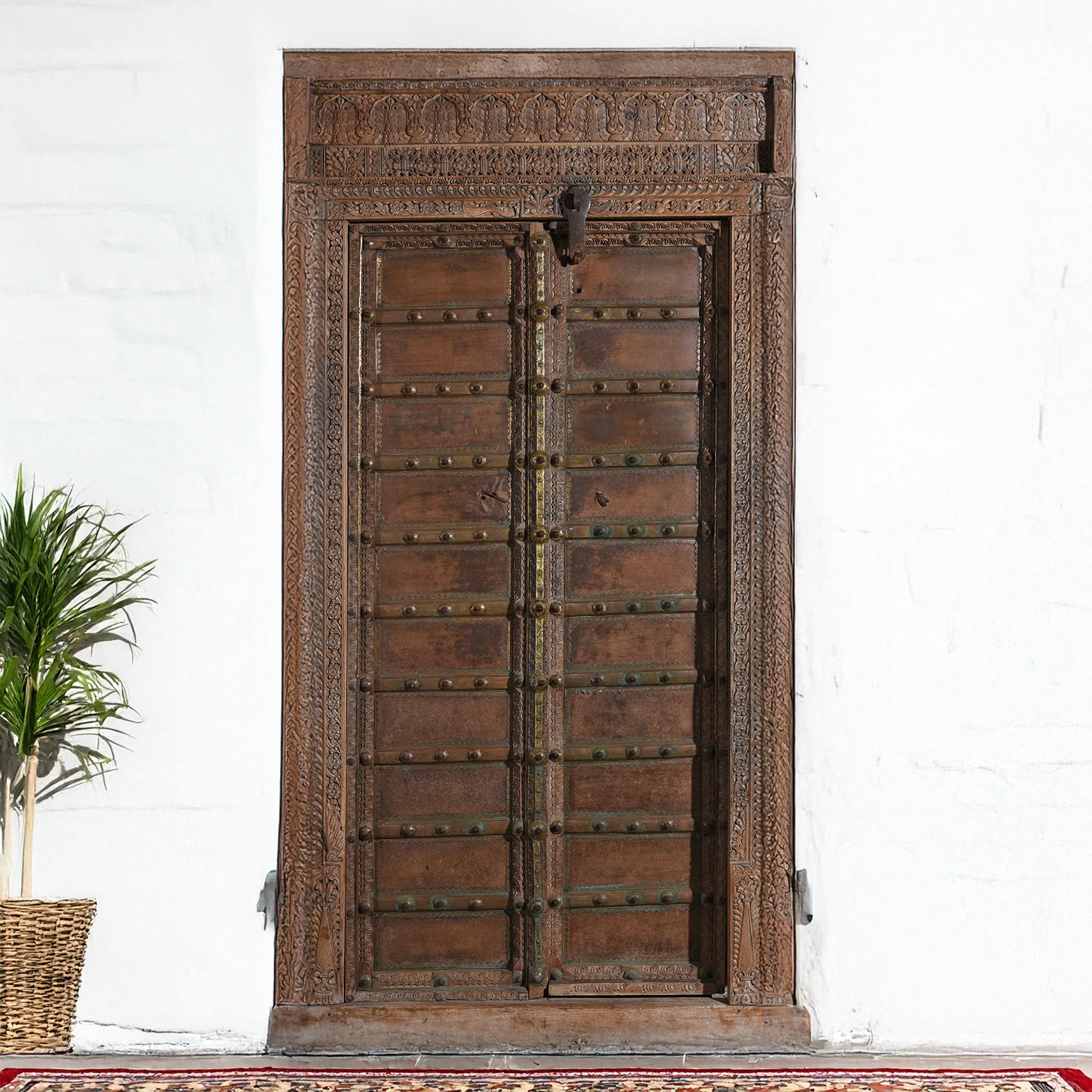
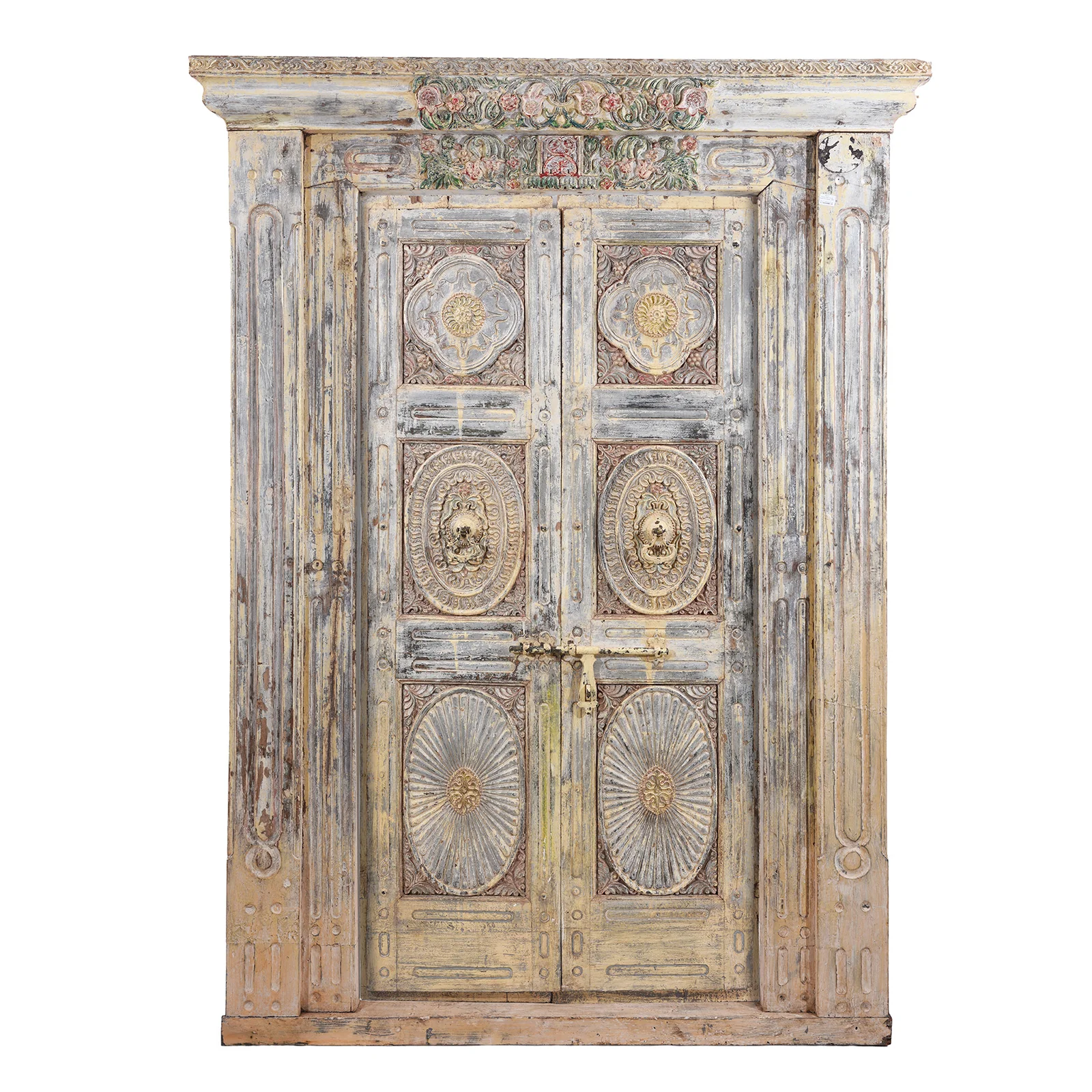
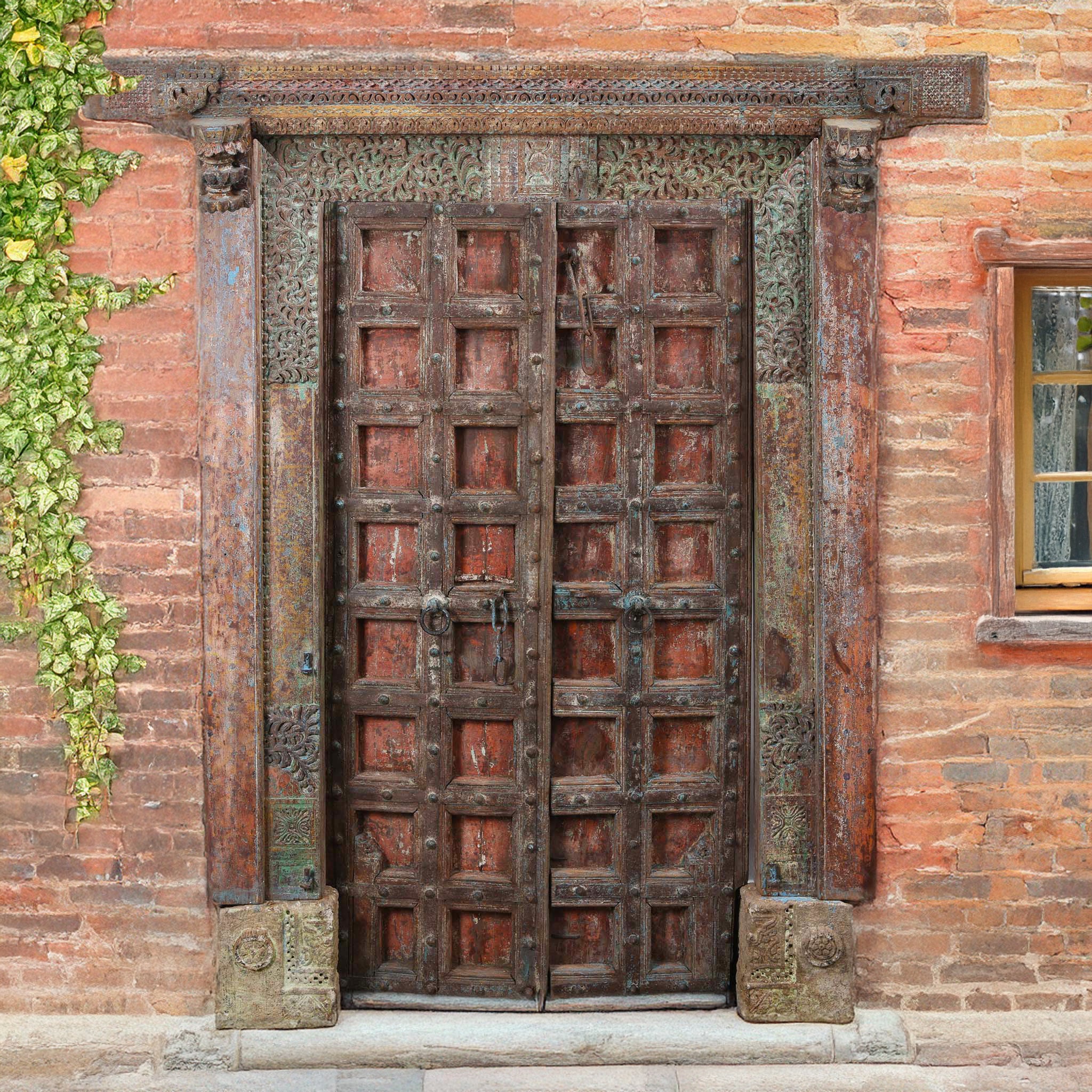
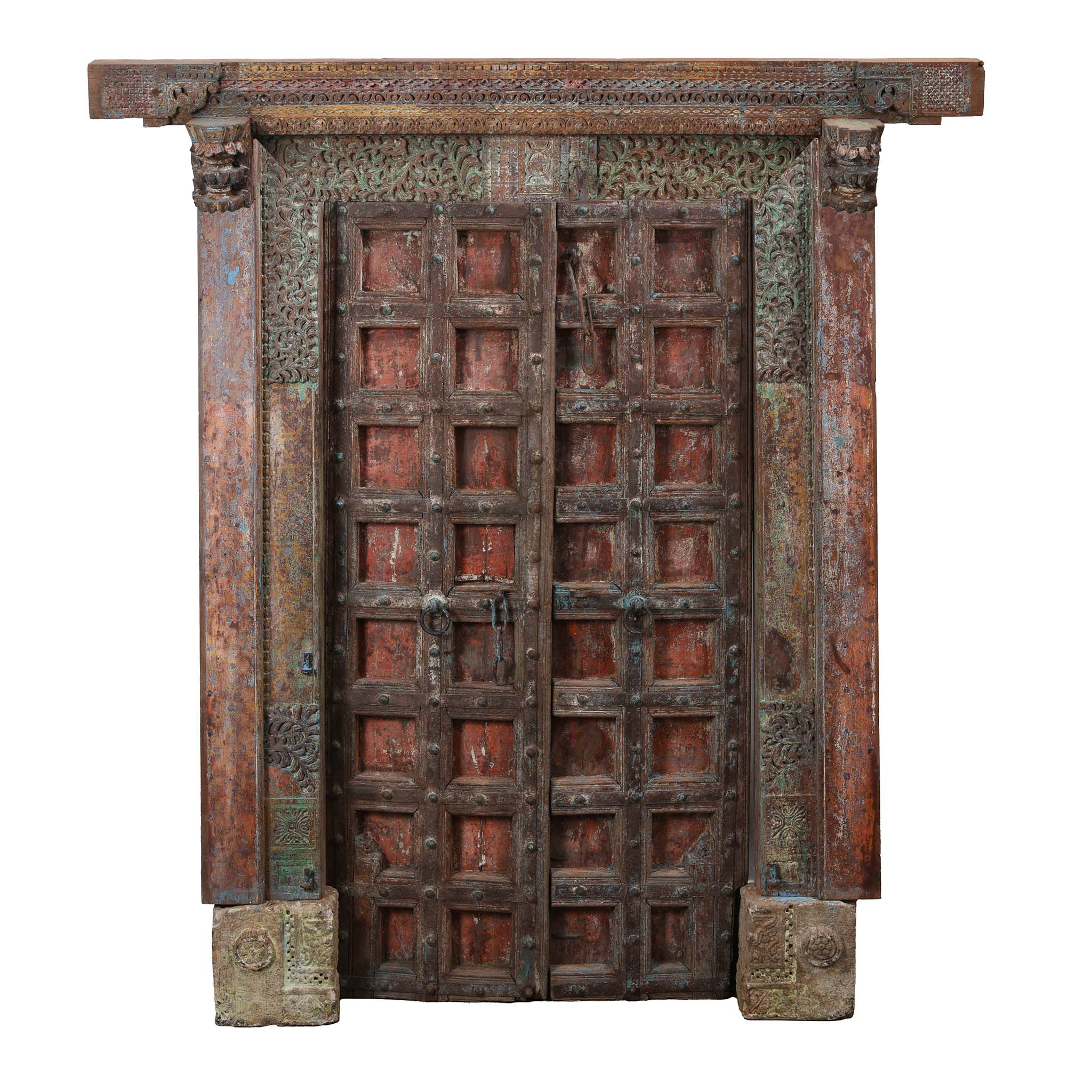
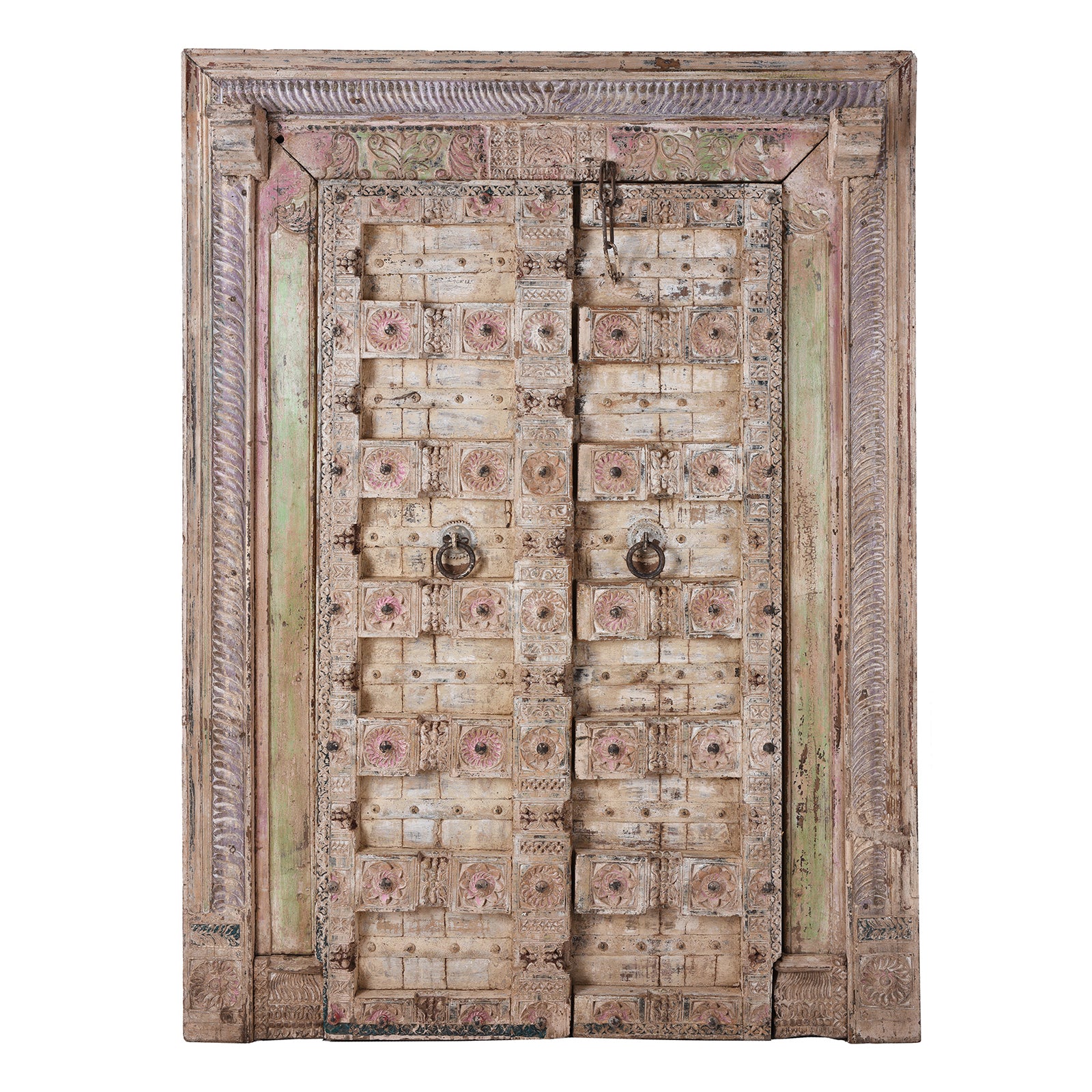
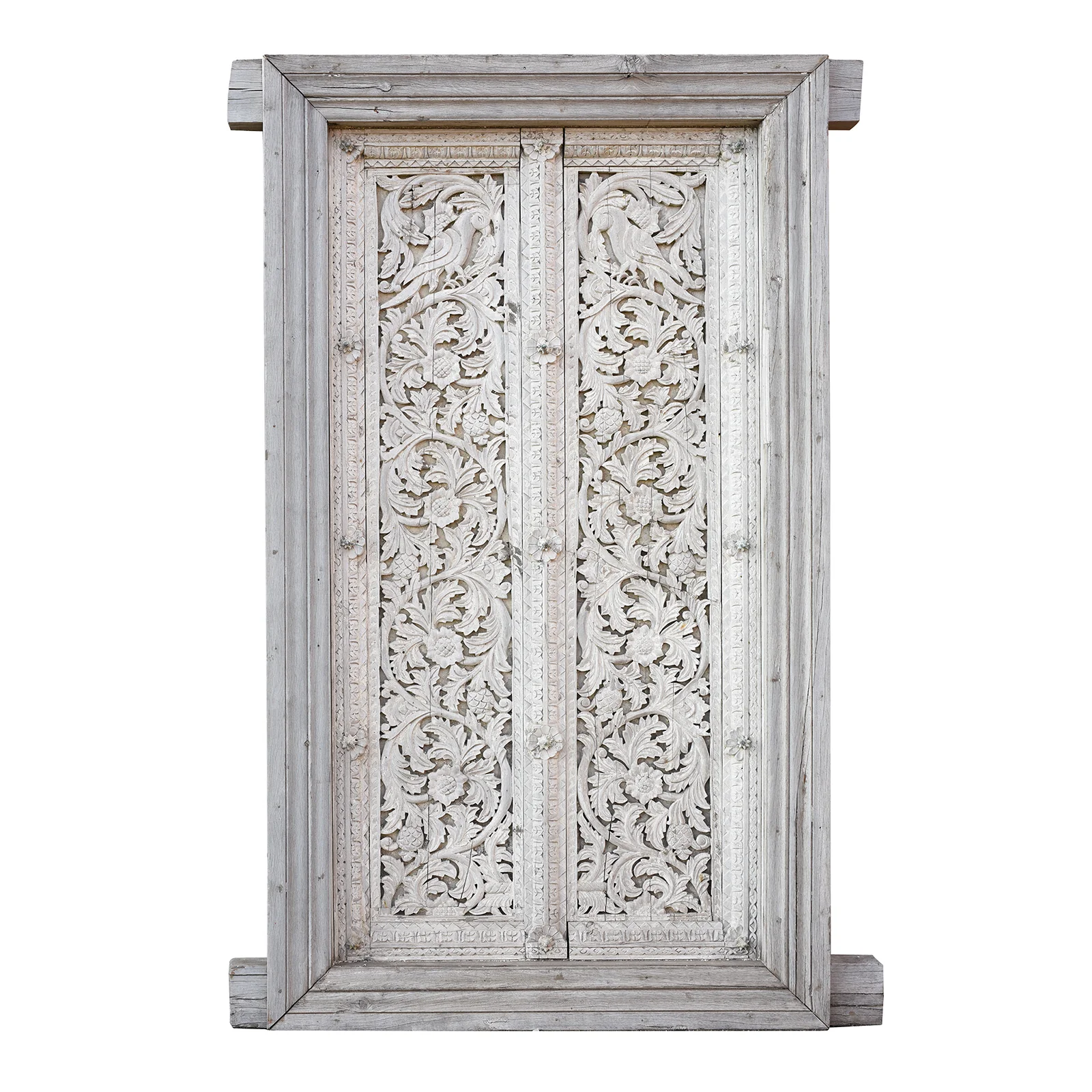
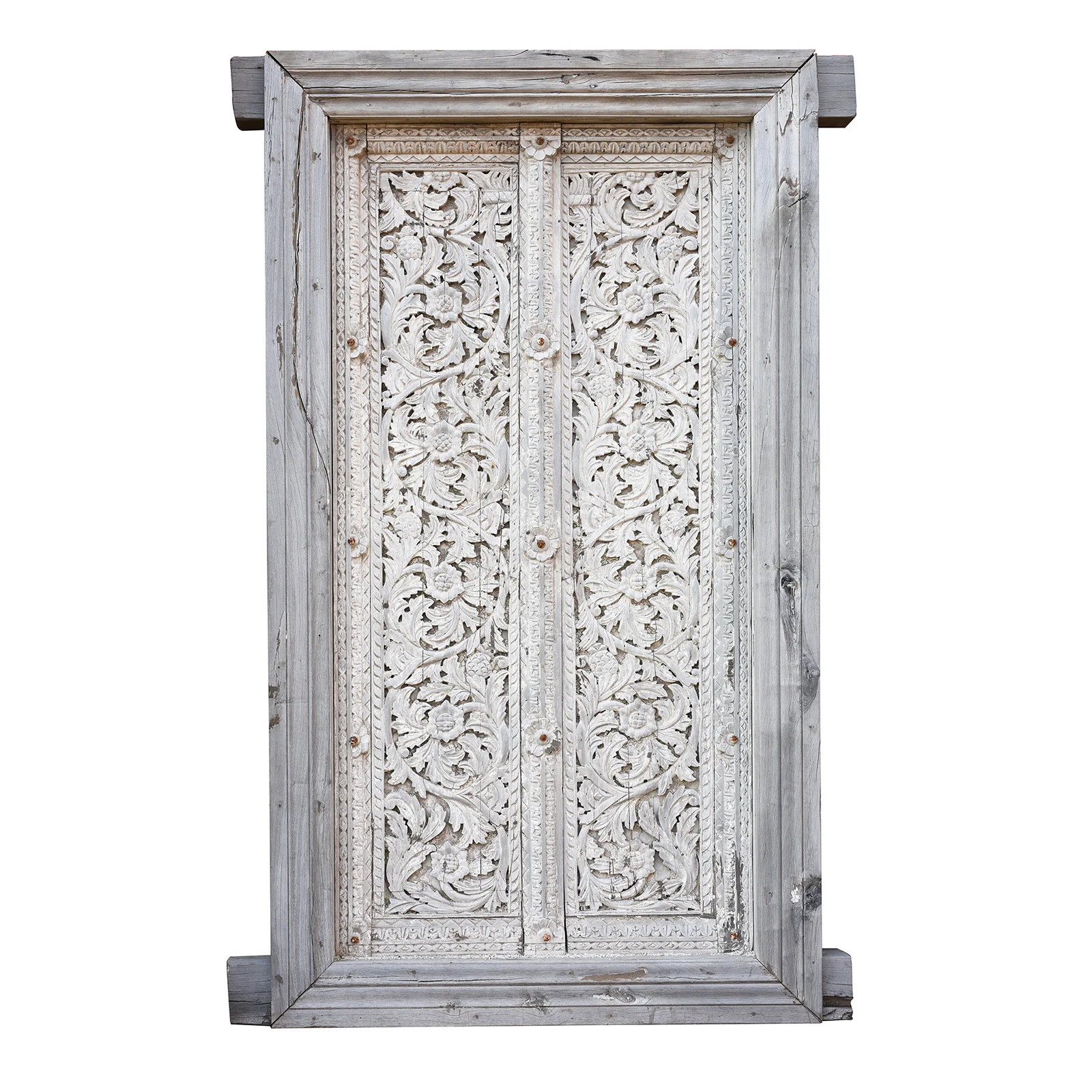
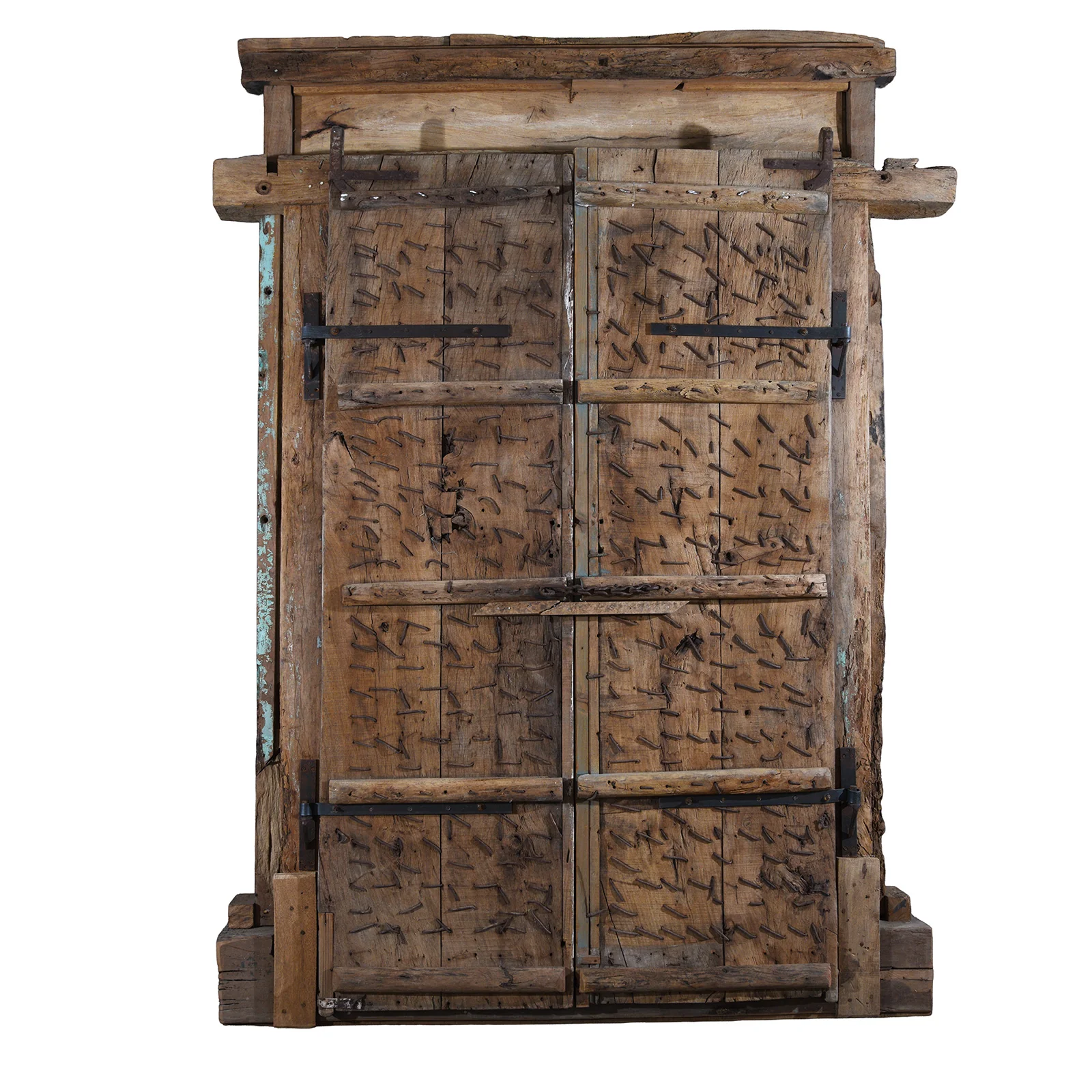
This magnificent early 19th-century carved teak door originates from a Punjabi haveli (traditional townhouse). Hand-carved from solid teak, it represents the highest level of regional craftsmanship, with exceptionally deep relief work across its frame and panels. The central lintel features a beautifully rendered Ganesha—the remover of obstacles and guardian of thresholds—flanked by six kalaśa (sacred vessels) from which scrolling foliage and blossoms emerge, symbolising fertility, abundance, and divine prosperity.
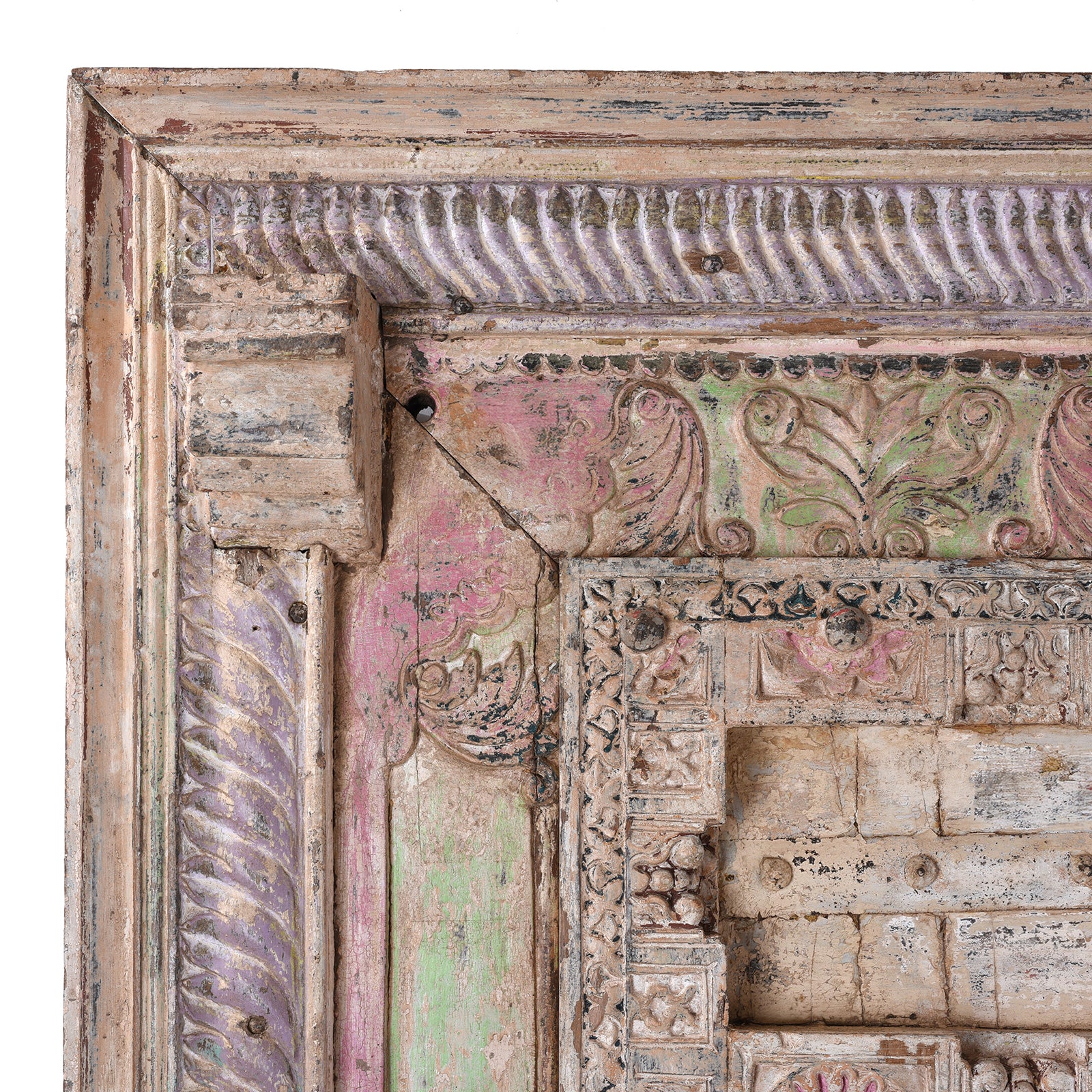
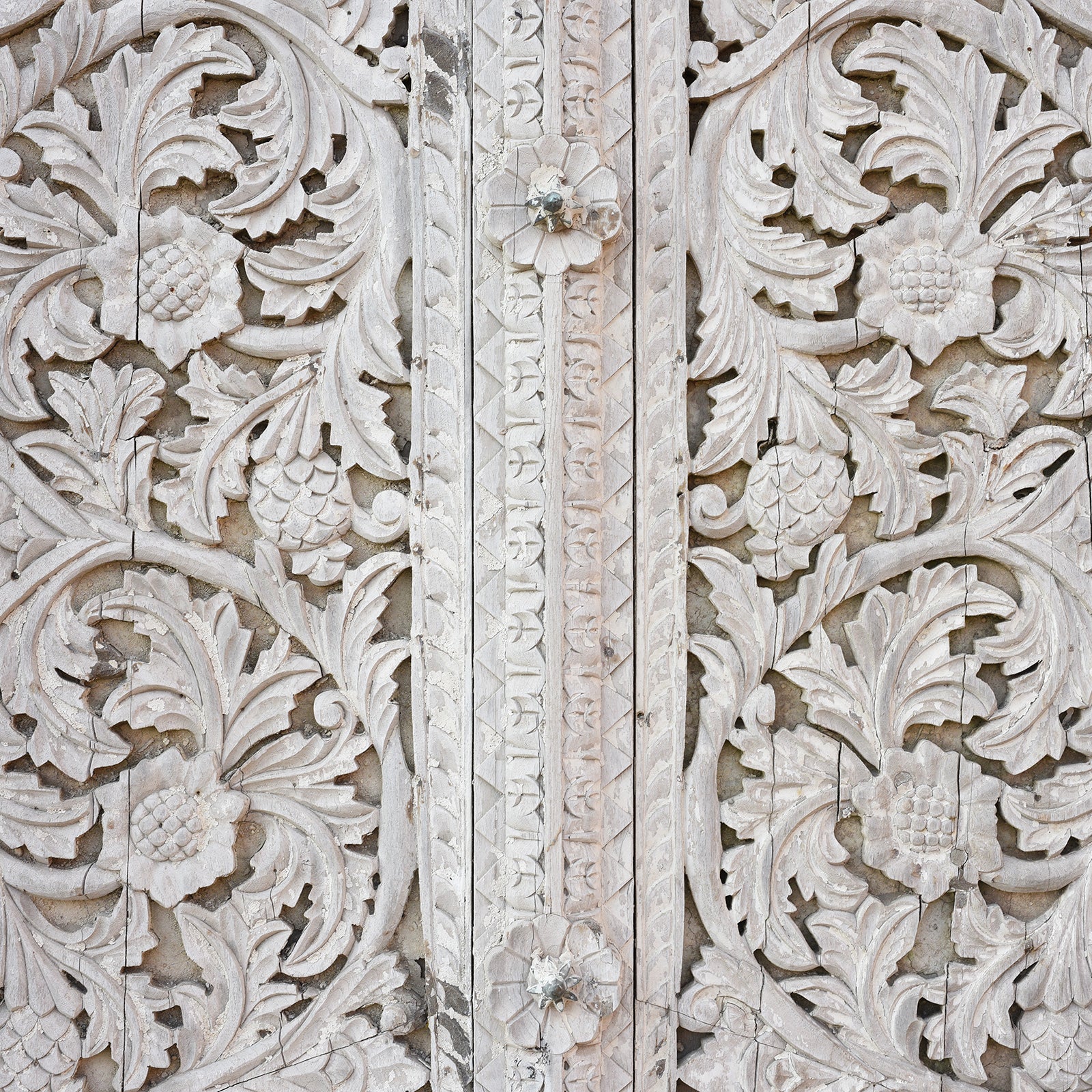
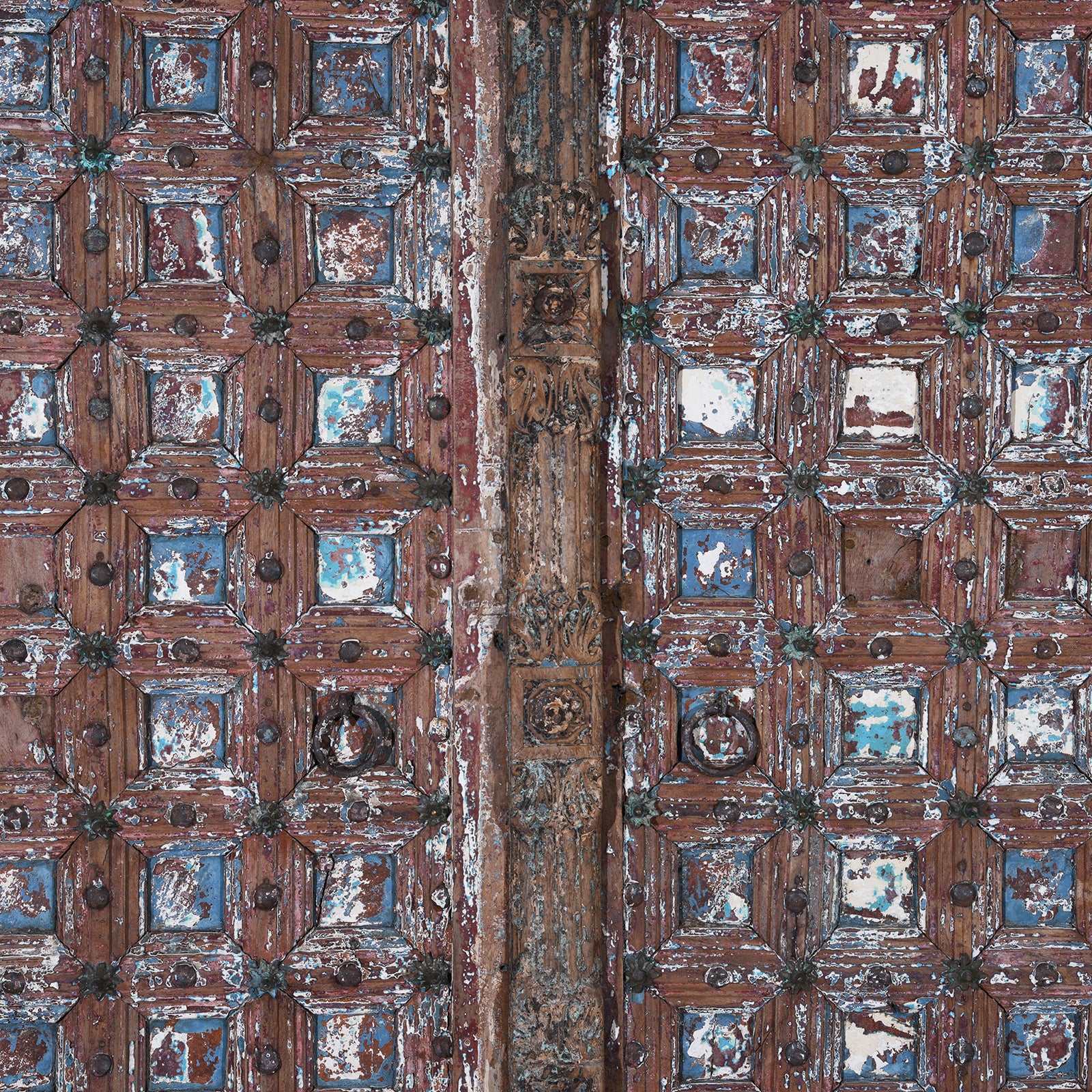
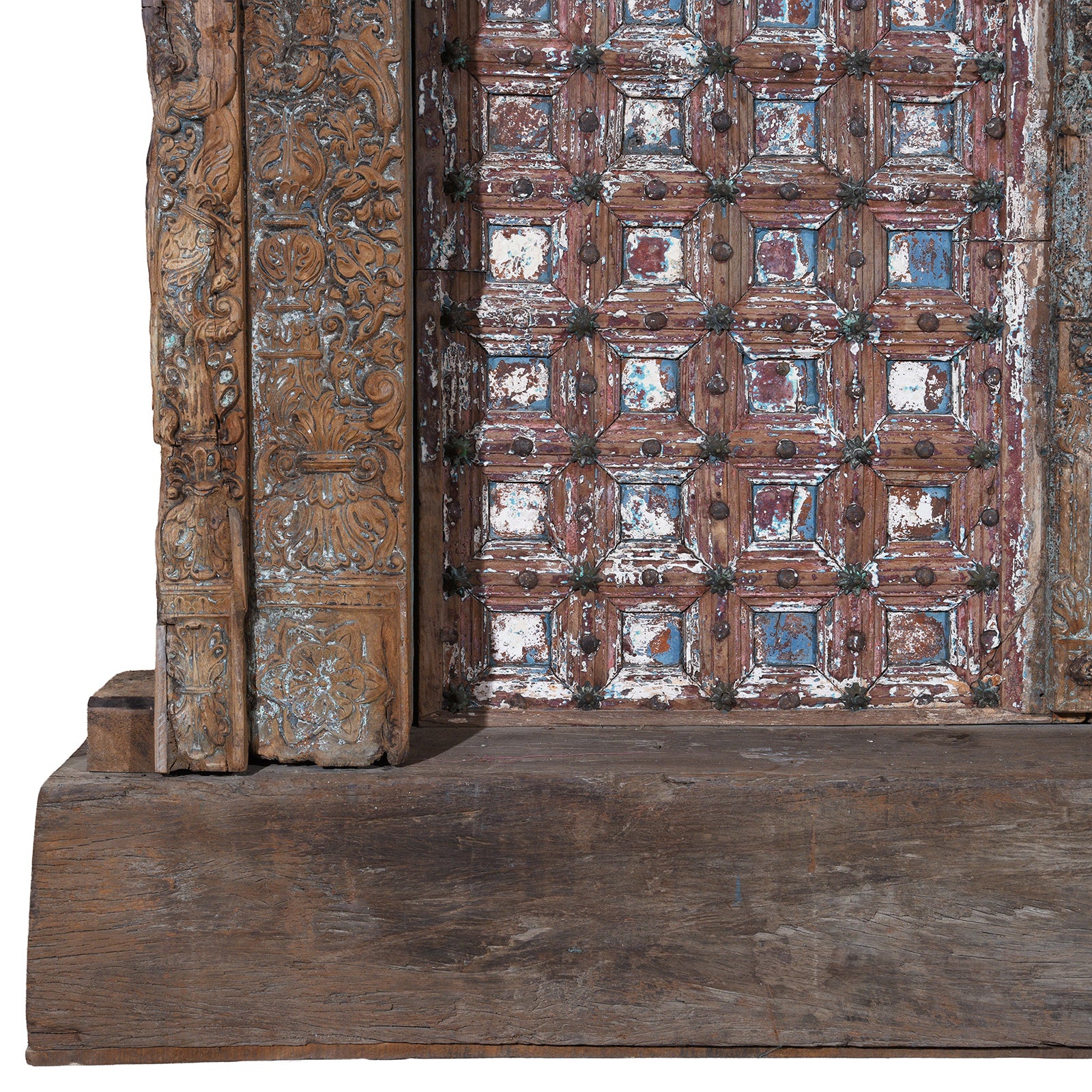
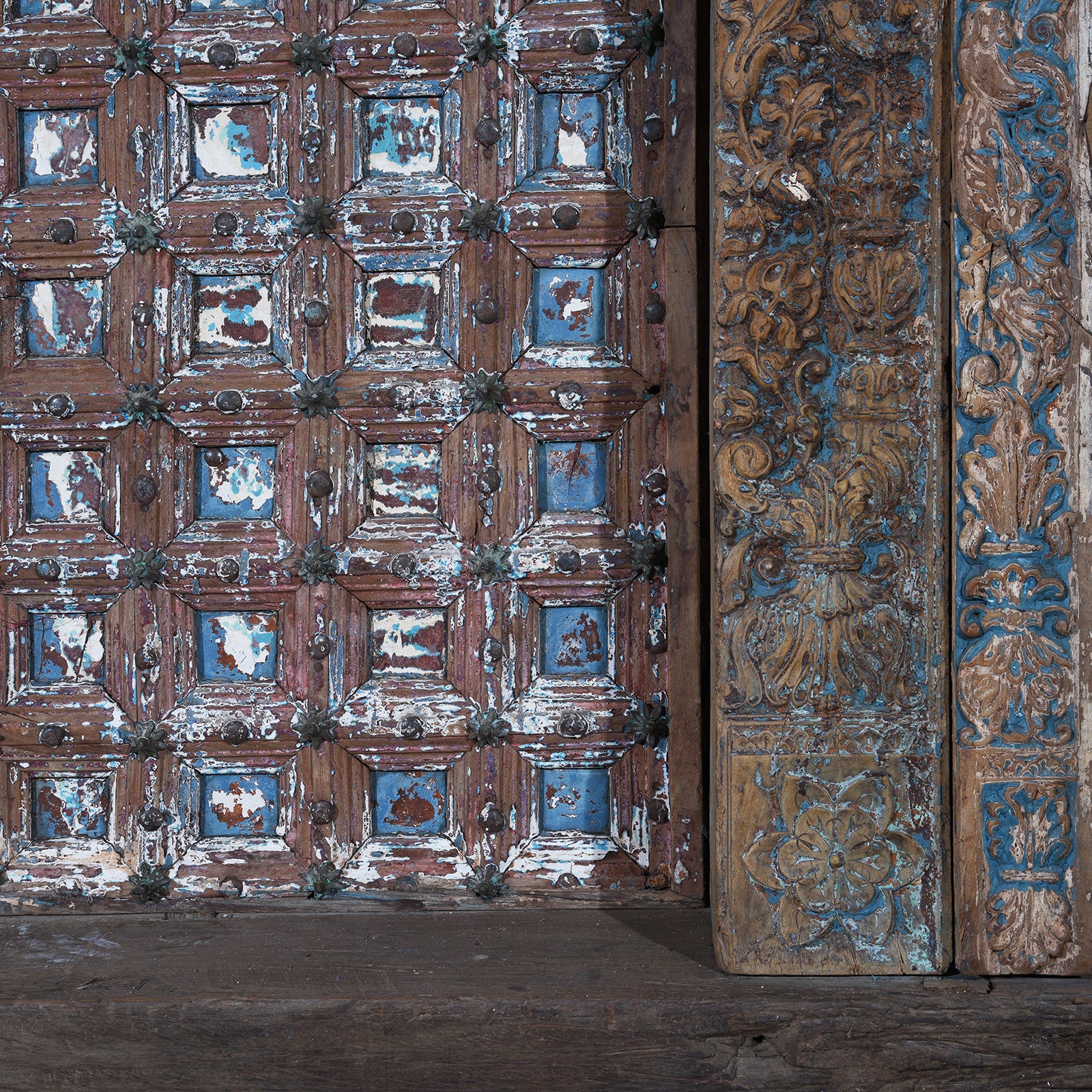
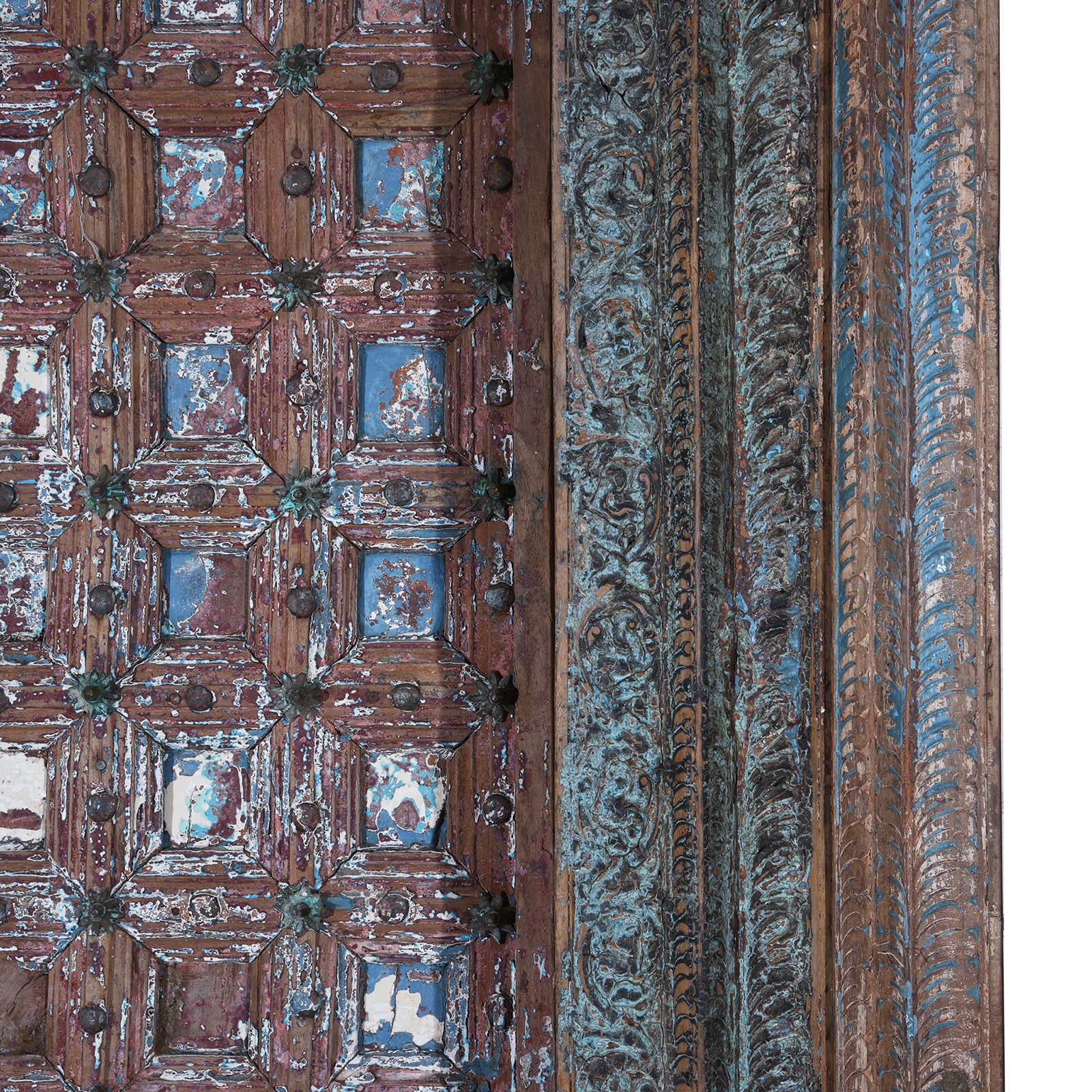
Above Ganesha runs a band of lotus and palmette carving, evoking purity and cosmic order, while the surrounding panels display dense foliate arabesques and rosette motifs in high relief. The doors themselves are arranged in a robust grid of square panels with original iron bosses, traces of their original blue and red pigment still visible across the surface. Together, these elements form a visual invocation of auspiciousness—śubha-lābha—that would once have sanctified the entrance of a prosperous household.
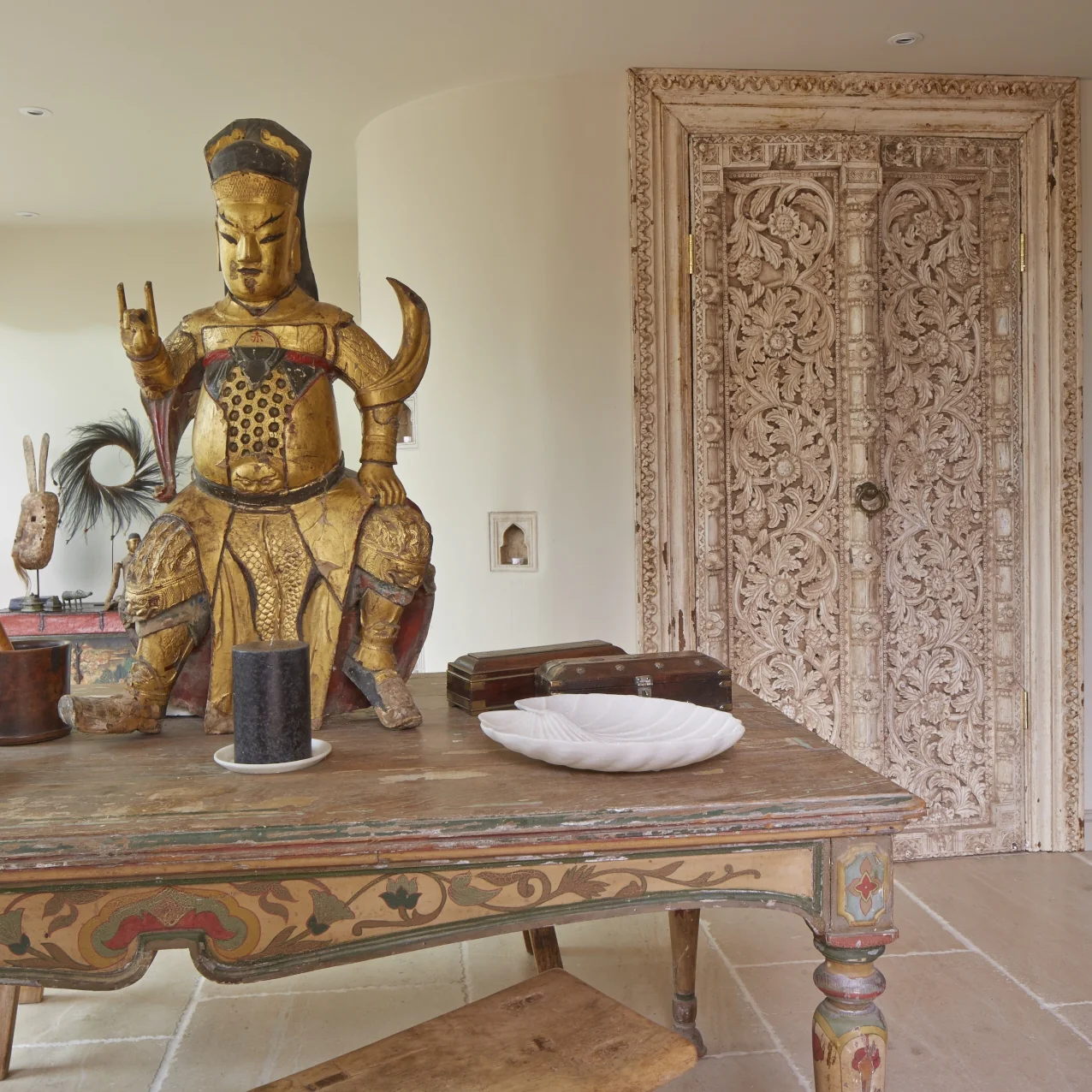
The door’s impressive scale and weight attest to its architectural origin, designed as a fully functional entrance. It remains structurally sound and can be built into a property (with guidance provided). The lower beam can be removed if required, and the entire assembly can be flat-packed for transport. Hinges may be adapted or replaced to suit modern installation. We are happy to consult with you and your builders to customise this to fit perfectly in your home.
- Origin: Punjab, India
- Date: Early 19th Century
- Materials: Teak wood with traces of original pigment and ironwork
- Features: Central Ganesha lintel flanked by kalaśa motifs, deep foliate and rosette carvings, grid-panelled doors with original iron bosses, traces of blue and red pigment, substantial size and weight
- Condition: Naturally aged surface with weathering and patina consistent with age; structurally sound and suitable for installation
- Dimensions: W167 × D22 × H265 cm
- Internal Door Dimensions: W122 x H187 cm
- Step Height: 24cm (Step can be removed on request in our workshops)
- Installation Notes: Beam at base removable; door can be flat-packed for transport; hinge positions adaptable to modern fittings
Original: $6,103.01
-65%$6,103.01
$2,136.05More Images
Painted & Carved Door From The Punjab - 19th Century
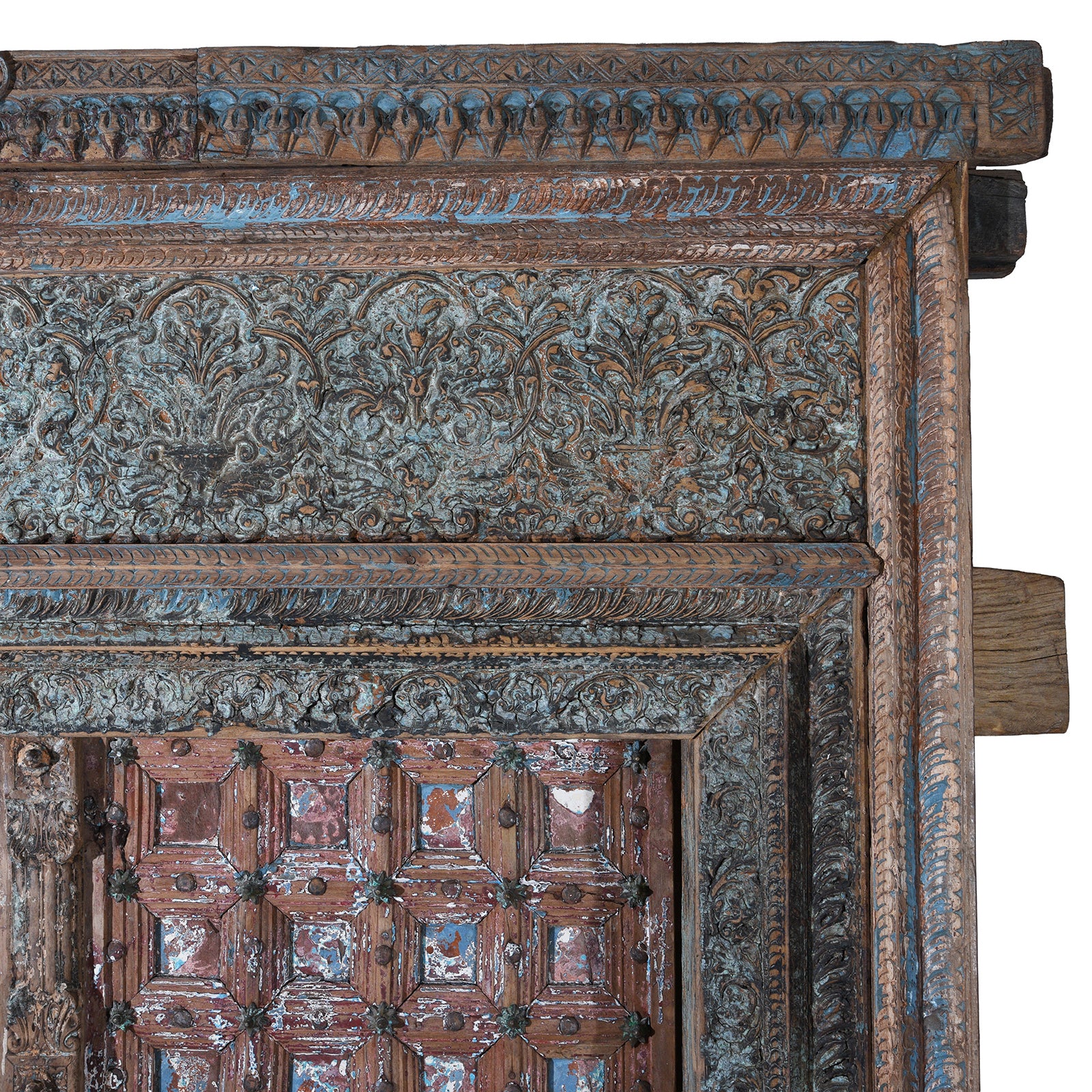
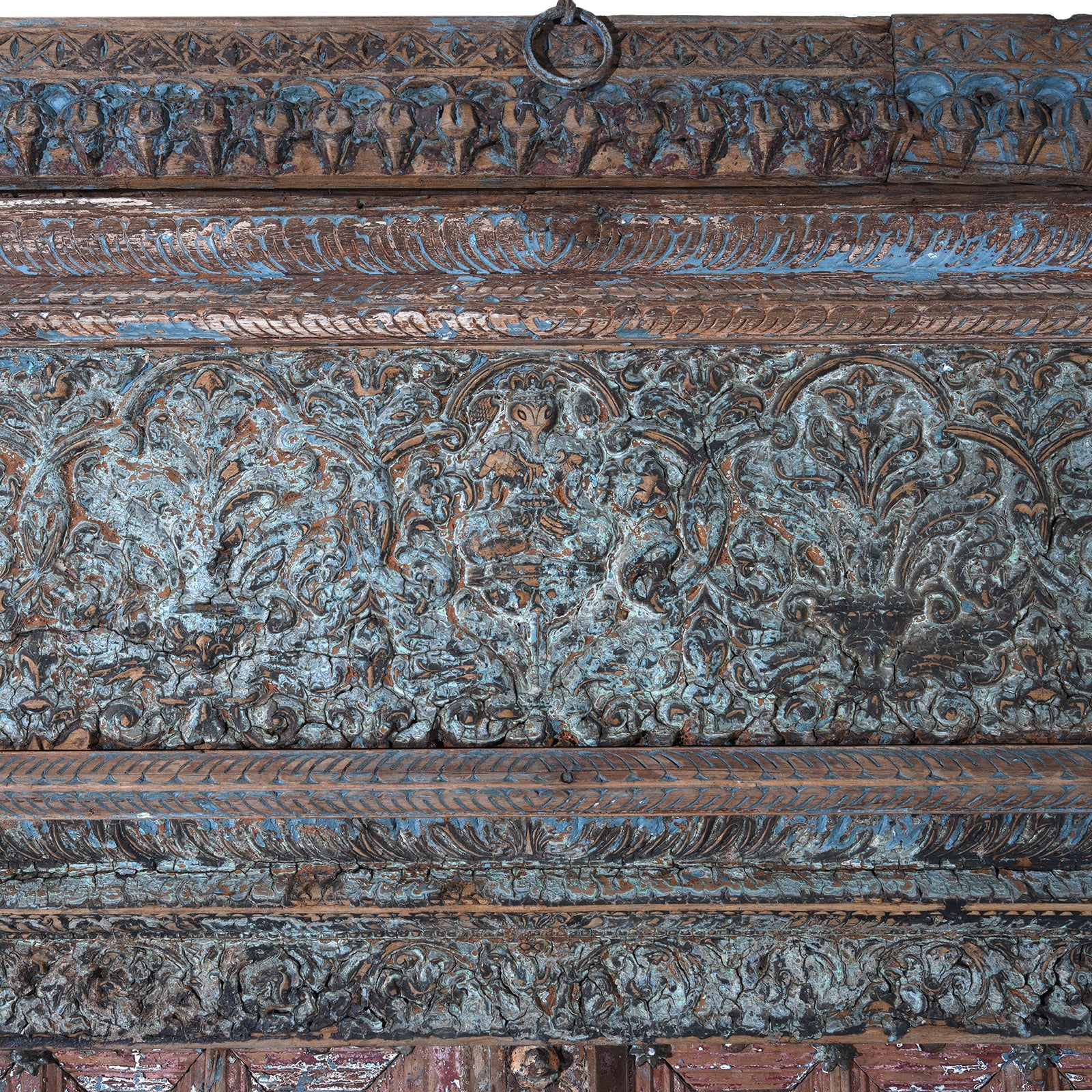
This magnificent early 19th-century carved teak door originates from a Punjabi haveli (traditional townhouse). Hand-carved from solid teak, it represents the highest level of regional craftsmanship, with exceptionally deep relief work across its frame and panels. The central lintel features a beautifully rendered Ganesha—the remover of obstacles and guardian of thresholds—flanked by six kalaśa (sacred vessels) from which scrolling foliage and blossoms emerge, symbolising fertility, abundance, and divine prosperity.
Above Ganesha runs a band of lotus and palmette carving, evoking purity and cosmic order, while the surrounding panels display dense foliate arabesques and rosette motifs in high relief. The doors themselves are arranged in a robust grid of square panels with original iron bosses, traces of their original blue and red pigment still visible across the surface. Together, these elements form a visual invocation of auspiciousness—śubha-lābha—that would once have sanctified the entrance of a prosperous household.
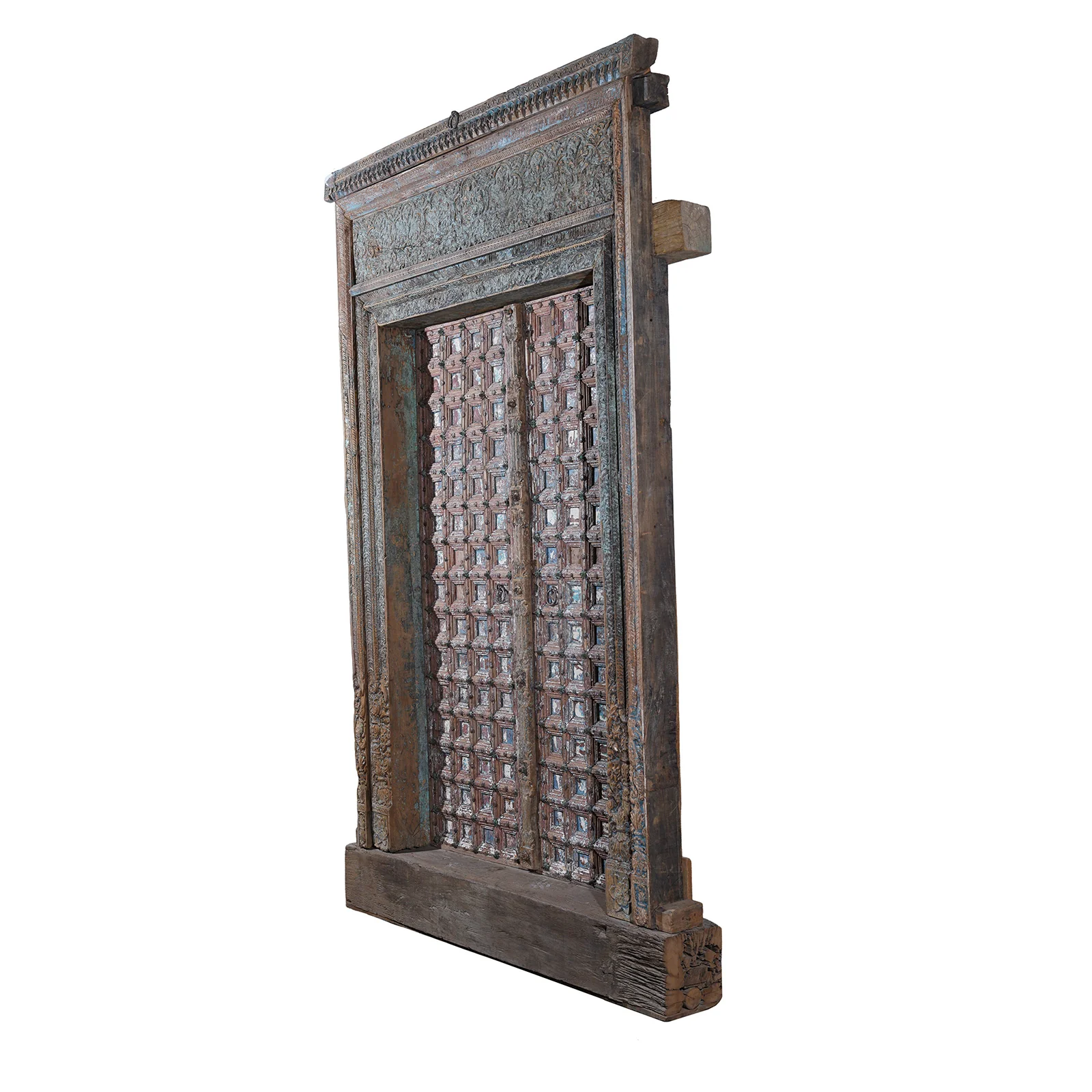
The door’s impressive scale and weight attest to its architectural origin, designed as a fully functional entrance. It remains structurally sound and can be built into a property (with guidance provided). The lower beam can be removed if required, and the entire assembly can be flat-packed for transport. Hinges may be adapted or replaced to suit modern installation. We are happy to consult with you and your builders to customise this to fit perfectly in your home.
- Origin: Punjab, India
- Date: Early 19th Century
- Materials: Teak wood with traces of original pigment and ironwork
- Features: Central Ganesha lintel flanked by kalaśa motifs, deep foliate and rosette carvings, grid-panelled doors with original iron bosses, traces of blue and red pigment, substantial size and weight
- Condition: Naturally aged surface with weathering and patina consistent with age; structurally sound and suitable for installation
- Dimensions: W167 × D22 × H265 cm
- Internal Door Dimensions: W122 x H187 cm
- Step Height: 24cm (Step can be removed on request in our workshops)
- Installation Notes: Beam at base removable; door can be flat-packed for transport; hinge positions adaptable to modern fittings
Product Information
Product Information
Shipping & Returns
Shipping & Returns
Description
This magnificent early 19th-century carved teak door originates from a Punjabi haveli (traditional townhouse). Hand-carved from solid teak, it represents the highest level of regional craftsmanship, with exceptionally deep relief work across its frame and panels. The central lintel features a beautifully rendered Ganesha—the remover of obstacles and guardian of thresholds—flanked by six kalaśa (sacred vessels) from which scrolling foliage and blossoms emerge, symbolising fertility, abundance, and divine prosperity.
Above Ganesha runs a band of lotus and palmette carving, evoking purity and cosmic order, while the surrounding panels display dense foliate arabesques and rosette motifs in high relief. The doors themselves are arranged in a robust grid of square panels with original iron bosses, traces of their original blue and red pigment still visible across the surface. Together, these elements form a visual invocation of auspiciousness—śubha-lābha—that would once have sanctified the entrance of a prosperous household.
The door’s impressive scale and weight attest to its architectural origin, designed as a fully functional entrance. It remains structurally sound and can be built into a property (with guidance provided). The lower beam can be removed if required, and the entire assembly can be flat-packed for transport. Hinges may be adapted or replaced to suit modern installation. We are happy to consult with you and your builders to customise this to fit perfectly in your home.
- Origin: Punjab, India
- Date: Early 19th Century
- Materials: Teak wood with traces of original pigment and ironwork
- Features: Central Ganesha lintel flanked by kalaśa motifs, deep foliate and rosette carvings, grid-panelled doors with original iron bosses, traces of blue and red pigment, substantial size and weight
- Condition: Naturally aged surface with weathering and patina consistent with age; structurally sound and suitable for installation
- Dimensions: W167 × D22 × H265 cm
- Internal Door Dimensions: W122 x H187 cm
- Step Height: 24cm (Step can be removed on request in our workshops)
- Installation Notes: Beam at base removable; door can be flat-packed for transport; hinge positions adaptable to modern fittings