
Elephant & Peacock Corbel From Gujarat - 19th Century
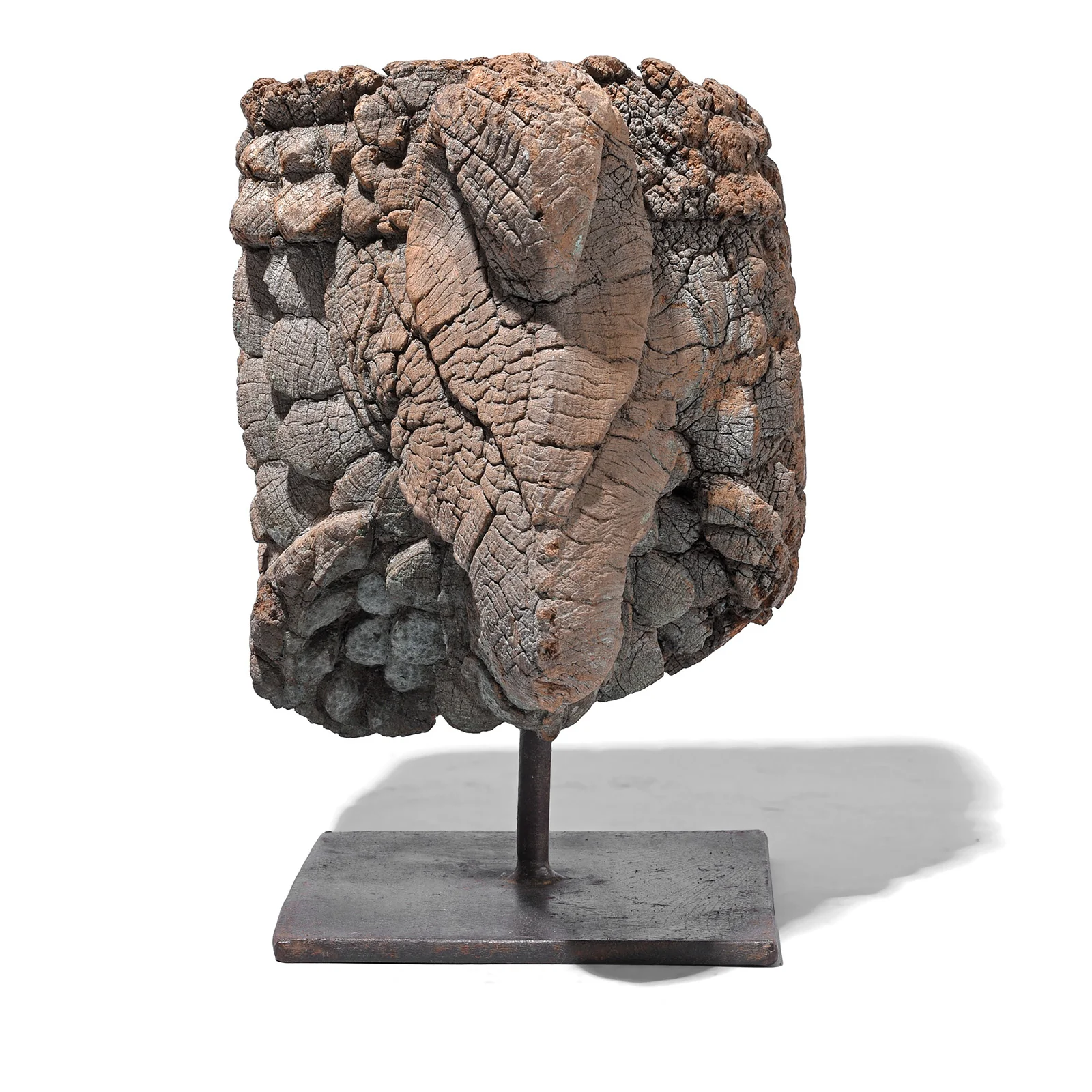
This 19th-century carved teak corbel from Gujarat is a striking sculptural fragment depicting a stylised elephant with a peacock perched on its head—a motif symbolising strength, protection and auspiciousness in traditional Indian architecture. Once part of the supporting structure of a haveli (merchant’s mansion), this corbel would have adorned an exterior or interior beam, adding both decorative richness and cultural meaning to the building.
The carving has weathered beautifully over time, with the teak’s surface developing deep, tactile fissures and a naturally aged patina. Despite its erosion, the forms of the elephant’s curling trunk and the peacock’s feathered body remain clearly recognisable, giving the piece a powerful, almost totemic presence. Now mounted on a custom iron stand, it displays as a dramatic sculptural object, perfect for collectors of folk art, architectural salvage or South Asian craft traditions.
- Origin: Gujarat, India
- Date: 19th Century
- Materials: Carved teak mounted on an iron stand
- Features: Stylised elephant and peacock motif; deeply weathered surface; architectural corbel from a haveli
- Condition: Surface erosion and fissures consistent with age and long exposure
- Dimensions: W15 x D20 x H22 cm
Original: $132.50
-65%$132.50
$46.38More Images


Elephant & Peacock Corbel From Gujarat - 19th Century
This 19th-century carved teak corbel from Gujarat is a striking sculptural fragment depicting a stylised elephant with a peacock perched on its head—a motif symbolising strength, protection and auspiciousness in traditional Indian architecture. Once part of the supporting structure of a haveli (merchant’s mansion), this corbel would have adorned an exterior or interior beam, adding both decorative richness and cultural meaning to the building.
The carving has weathered beautifully over time, with the teak’s surface developing deep, tactile fissures and a naturally aged patina. Despite its erosion, the forms of the elephant’s curling trunk and the peacock’s feathered body remain clearly recognisable, giving the piece a powerful, almost totemic presence. Now mounted on a custom iron stand, it displays as a dramatic sculptural object, perfect for collectors of folk art, architectural salvage or South Asian craft traditions.
- Origin: Gujarat, India
- Date: 19th Century
- Materials: Carved teak mounted on an iron stand
- Features: Stylised elephant and peacock motif; deeply weathered surface; architectural corbel from a haveli
- Condition: Surface erosion and fissures consistent with age and long exposure
- Dimensions: W15 x D20 x H22 cm
Product Information
Product Information
Shipping & Returns
Shipping & Returns
Description
This 19th-century carved teak corbel from Gujarat is a striking sculptural fragment depicting a stylised elephant with a peacock perched on its head—a motif symbolising strength, protection and auspiciousness in traditional Indian architecture. Once part of the supporting structure of a haveli (merchant’s mansion), this corbel would have adorned an exterior or interior beam, adding both decorative richness and cultural meaning to the building.
The carving has weathered beautifully over time, with the teak’s surface developing deep, tactile fissures and a naturally aged patina. Despite its erosion, the forms of the elephant’s curling trunk and the peacock’s feathered body remain clearly recognisable, giving the piece a powerful, almost totemic presence. Now mounted on a custom iron stand, it displays as a dramatic sculptural object, perfect for collectors of folk art, architectural salvage or South Asian craft traditions.
- Origin: Gujarat, India
- Date: 19th Century
- Materials: Carved teak mounted on an iron stand
- Features: Stylised elephant and peacock motif; deeply weathered surface; architectural corbel from a haveli
- Condition: Surface erosion and fissures consistent with age and long exposure
- Dimensions: W15 x D20 x H22 cm